

10kV Heat Shrink Cable Termination Kit: Selection, Specs & Installation 2026
2026-04-27 23:09
Senior Technical Engineer · Hubei Zhizheng Rubber & Plastic New Material Corp., Ltd.
Published: 2026 · Reading time: 22 min
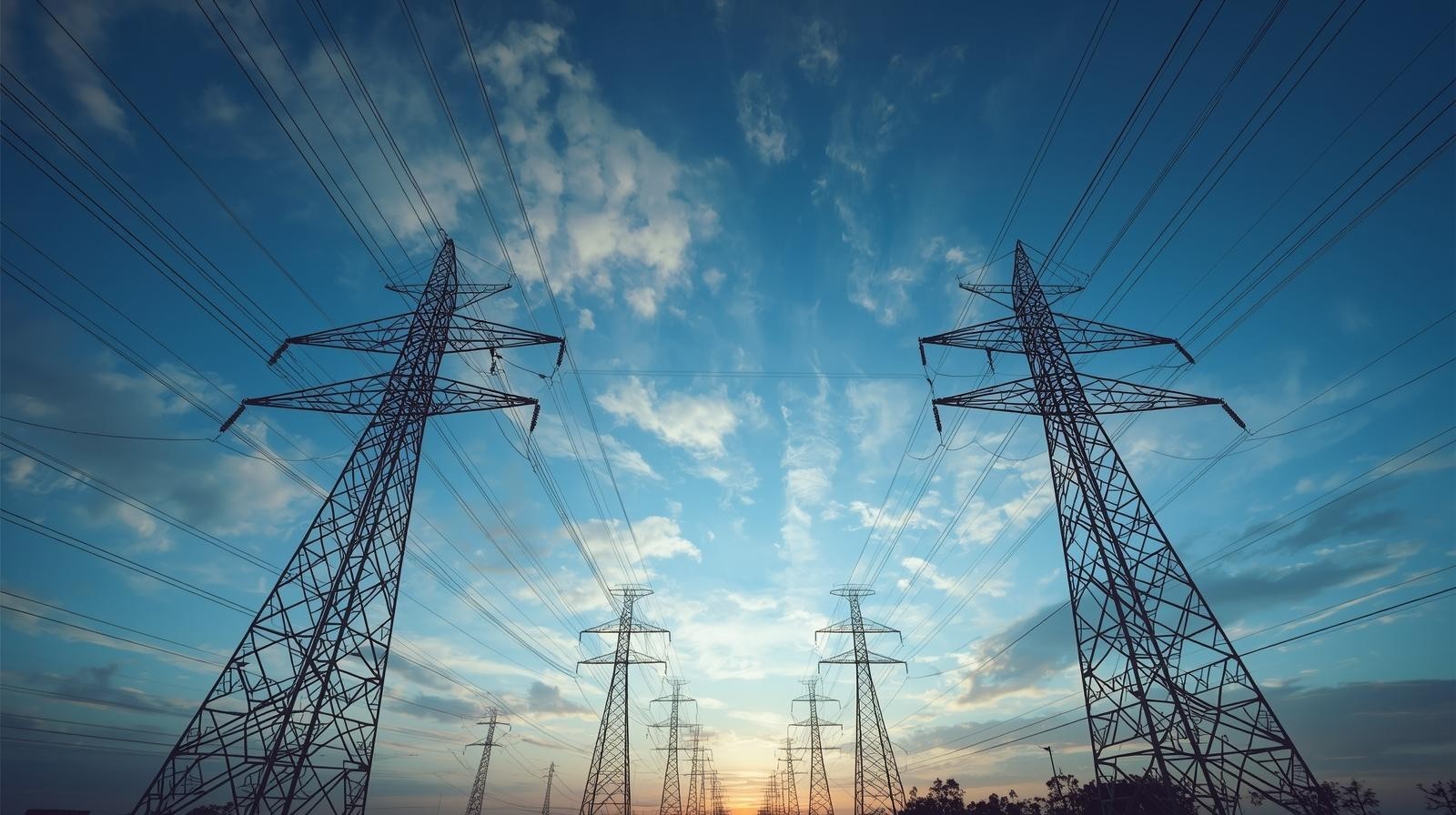
If you work in medium voltage power distribution — anywhere in the world — there's a very good chance that 10 kV is your everyday voltage class. It's the backbone of distribution networks from Jakarta to Riyadh, from Lagos to Manila. And at every single point where a 10 kV XLPE cable connects to a transformer, enters a ring main unit, transitions to an overhead line, or feeds into a switchgear panel, there's a cable termination sitting at that critical interface.
Get it wrong, and you invite partial discharge, moisture ingress, and eventual failure — sometimes within the first year. Get it right, and that termination works quietly for 25 years without anyone giving it a second thought.
I've been making 10kV heat shrink cable termination kits at our factory in Huangshi for over fifteen years. Our RSY-10 series ships to more than 30 countries. This article is everything I'd want a procurement engineer, a cable installation contractor, or a distributor to know before they place an order — the technical specifications, the selection logic, the installation steps that matter, and the compliance certifications you should be verifying. Not marketing copy. Real engineering guidance.
? Table of Contents
1. Why 10 kV Is the World's Most Critical Distribution Voltage
Before diving into product specifics, it's worth understanding why the 10 kV class matters so much — because that context shapes every technical requirement for 10kV cable accessories.
The 6/10 kV and 8.7/15 kV voltage classes (collectively referred to as "10 kV class" in most markets) are the workhorse of medium voltage power distribution globally. They carry power from primary substations to distribution transformers across urban, suburban, industrial, and rural networks. In terms of sheer installed circuit length, the 10 kV class exceeds all other MV voltage classes combined in most countries.
And the growth trajectory is steep. Global electricity demand is forecast to increase by an average of 3.3% in 2025 and by 3.7% in 2026 — strong demand increases from industries, air conditioning, and data centres, as well as significant strides in electrification, are expected to support growth in electricity use through 2026. Every megawatt-hour of that additional demand passes through MV distribution infrastructure — and every cable connection within that infrastructure requires a properly specified termination.
The medium voltage cable and accessory market is projected to grow from USD 58.2 billion in 2026 to USD 98.5 billion by 2036, at a CAGR of 5.4%. Asia Pacific is expected to be the fastest-growing region, capturing a market share of 42.8%. The regions driving this growth — Southeast Asia, the Middle East, and Sub-Saharan Africa — are precisely the markets where 10 kV-class distribution is being deployed at scale for urban expansion, industrial development, and rural electrification.
This is not a niche product category. It's the foundation of modern power distribution.
2. What Exactly Is a 10kV Heat Shrink Cable Termination Kit?
A 10kV heat shrink cable termination kit is a pre-engineered set of cross-linked polymer components designed to seal, insulate, and protect the open end of a 6/10 kV or 8.7/15 kV power cable at its connection point to electrical equipment — switchgear, transformers, overhead line transitions, or motor terminals.
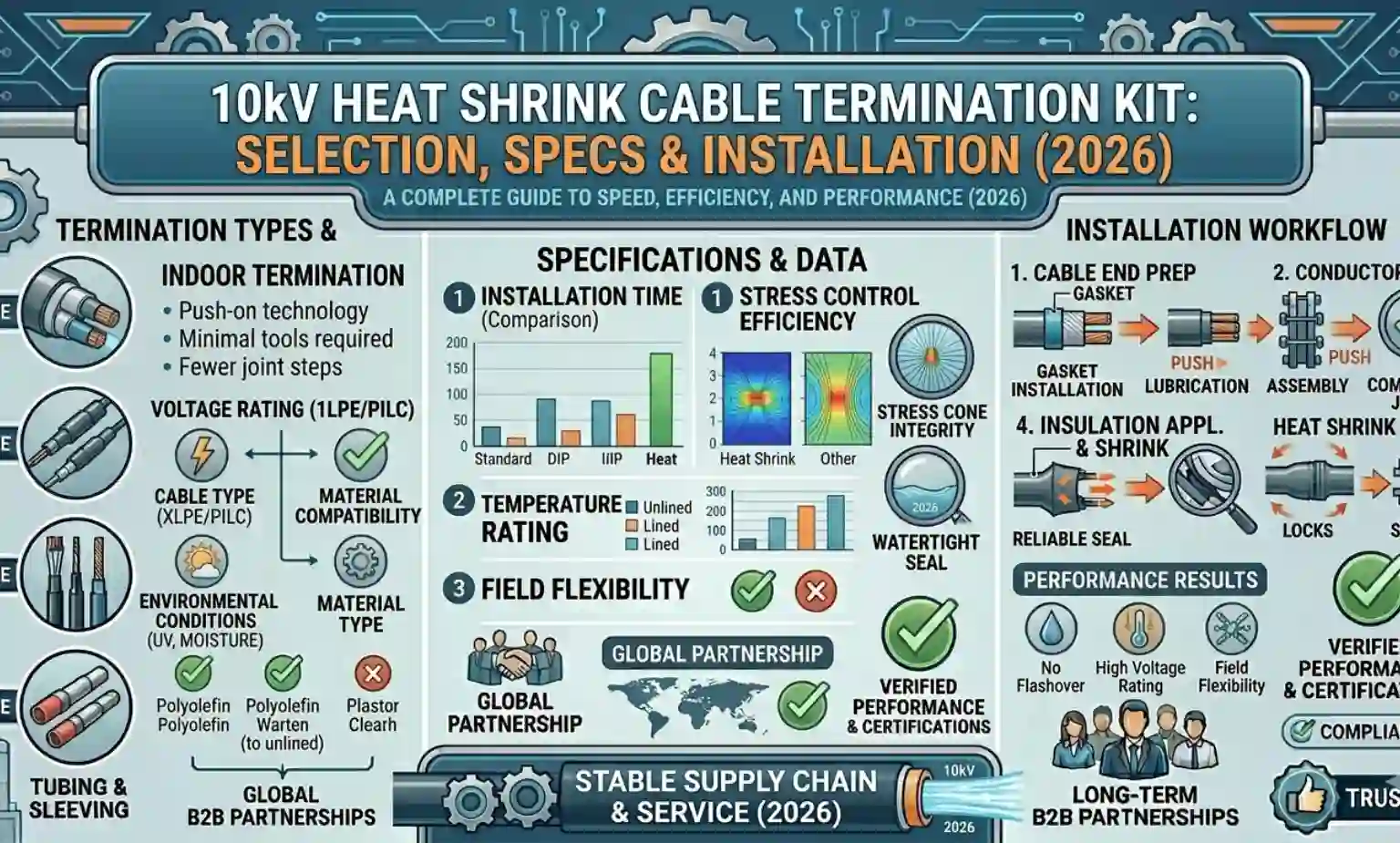
The kit reconstructs the cable's complete insulation system at the point where the factory-made cable has been stripped open. It must restore four critical functions:
Stress control — smoothing the electrical field concentration at the semiconductive screen cutback point.
Insulation — maintaining the cable's dielectric integrity through the termination zone.
Environmental sealing — preventing moisture, dust, and contaminants from entering the exposed cable layers.
Mechanical protection — shielding the termination from physical damage, UV degradation (outdoor), and thermal cycling.
When the installer applies heat (typically 90–130°C using an industrial heat gun), each component shrinks to conform tightly around the cable substrate, creating void-free interfaces that ensure long-term electrical performance.
3. Inside the Kit: Component Breakdown & Function
Every RSY-10 kit contains specific components designed to work together as an integrated system. Let me walk through them from the inside out — the order they're applied during installation.
3.1 Three-Core Kit (RSY-10/3.x) — Full Component List
| Component | Material | Function | Qty per Kit |
|---|---|---|---|
| Stress Control Tube | High-permittivity polyolefin (ZnO/SiC-loaded) | Smooths electrical field at semiconductor screen cutback; prevents PD initiation | 3 |
| Insulation Tube | Cross-linked polyolefin (irradiated PE) | Primary dielectric barrier; maintains insulation integrity through termination zone | 3 |
| Anti-Tracking Outer Tube / Rain Sheds | ATH-filled polyolefin (outdoor) / standard polyolefin (indoor) | Resists surface tracking from pollution; provides creepage distance (outdoor); UV protection | 3 |
| Heat Shrink Breakout Boot | Cross-linked polyolefin | Seals the crotch point where three cores separate from the common outer sheath | 1 |
| Sealing Mastic / Sealant Tape | Butyl rubber compound | Fills irregularities; creates moisture barrier at layer transitions and cable lug entry | As specified |
| Semiconductive Tape | Carbon-loaded self-amalgamating tape | Ensures continuous semiconductive screen at stress control interface | As specified |
| Ground Braid / Earth Lead | Tinned copper | Connects cable's metallic screen/shield to the equipment earth bus | 3 |
| Constant-Force Spring / Grounding Clamp | Stainless steel / copper alloy | Secures earth connection to cable's metallic screen | 3 |
3.2 Single-Core Kit (RSY-10/1.x)
Single-core kits contain the same functional layers but in quantities of one per phase. They're specified for single-core XLPE cables used in larger cross-section installations (typically ≥185 mm² where three-core cable becomes impractical) and for specific switchgear configurations requiring individual phase cable entries.
3.3 Why Every Component Matters
I want to emphasize something that sometimes gets lost in procurement discussions: you can't judge a kit by counting components. The quality differentiation is in the material formulation of each component — particularly the stress control tube and the insulation tube.
Our stress control tubes use precisely controlled ZnO-loaded cross-linked polyolefin with a permittivity range of ε = 15–25 (at 50 Hz, 20°C). Too low, and the stress grading is insufficient. Too high, and you get excessive capacitive current that creates localized heating. The compound formulation, irradiation dose, and expansion ratio all need to be precisely calibrated — and that's where manufacturing experience and process control make the difference between a kit that lasts 25 years and one that fails in 3.
4. RSY-10 Technical Specifications
Here are the core specifications for our RSY-10 series 10kV heat shrink cable termination kits. I'm presenting the actual technical data we provide to our engineering customers — not simplified marketing ranges.
4.1 Electrical Performance Specifications
| Parameter | Specification | Test Standard |
|---|---|---|
| Rated Voltage (U₀/U) | 6/10 kV; 8.7/15 kV | IEC 60502-4 |
| Highest System Voltage (Um) | 12 kV / 17.5 kV | IEC 60502-4 |
| Power Frequency Withstand Voltage (wet, outdoor) | 35 kV / 1 min | IEC 60502-4 |
| Lightning Impulse Withstand Voltage (BIL) | 95 kV (1.2/50 μs, 10 positive + 10 negative) | IEC 60502-4 |
| Partial Discharge (at 1.5 U₀) | ≤ 5 pC | IEC 60502-4 |
| 4-Hour Voltage Test | 2.5 U₀ for 4 hours — no breakdown | IEC 60502-4 |
4.2 Physical & Environmental Specifications
| Parameter | Specification |
|---|---|
| Operating Temperature Range | −55°C to +105°C (continuous) |
| Maximum Conductor Temperature | 90°C (XLPE cable) / 70°C (PVC cable) |
| Short-Circuit Temperature Rating | 250°C (5 seconds) |
| Shrink Initiation Temperature | ≥ 84°C |
| Full Recovery Temperature | 105–130°C |
| Radial Shrink Ratio | ≥ 2:1 (stress control & insulation tubes); ≥ 3:1 (breakout boot) |
| Longitudinal Shrinkage | ≤ 5% |
| UV Resistance (outdoor version) | 2,000 hours accelerated UV aging — no cracking, chalking, or dielectric degradation |
| Tracking Resistance (outdoor version) | IEC 60587 Class 1A3.5 (≥ 3.5 kV) |
| Expected Service Life | ≥ 20 years under normal operating conditions |
4.3 Conductor Size Matrix
| Kit Model | Core Configuration | Conductor Range (mm²) | Application |
|---|---|---|---|
| RSY-10/3.1 | 3-Core | 25–50 | Indoor / Outdoor |
| RSY-10/3.2 | 3-Core | 70–120 | Indoor / Outdoor |
| RSY-10/3.3 | 3-Core | 150–240 | Indoor / Outdoor |
| RSY-10/3.4 | 3-Core | 300–400 | Indoor / Outdoor |
| RSY-10/1.1 | Single-Core | 25–50 | Indoor / Outdoor |
| RSY-10/1.2 | Single-Core | 70–120 | Indoor / Outdoor |
| RSY-10/1.3 | Single-Core | 150–240 | Indoor / Outdoor |
| RSY-10/1.4 | Single-Core | 300–500 | Indoor / Outdoor |
5. How to Select the Right Kit for Your Cable
This is the section I wish every buyer would read carefully. Selection mistakes are the single biggest source of returns and site problems we see — and almost all of them are preventable.
Step 1: Confirm the System Voltage
This sounds obvious, but I've seen it go wrong. The RSY-10 series covers two rated voltage designations:
6/10 kV (Um = 12 kV) — most common in China, parts of Southeast Asia, and Middle East distribution networks
8.7/15 kV (Um = 17.5 kV) — common in some European-standard networks, North Africa, and select utilities with higher distribution voltages
The RSY-10 kit is designed and type-tested to handle both designations. But confirm your system voltage before ordering — if your network operates at 12/20 kV or higher, you need a 20 kV or 35 kV-rated kit, not an RSY-10.
Step 2: Identify the Cable Construction
You need to know:
Insulation type: XLPE (most common), EPR, or PVC
Core configuration: 3-core (most MV distribution cables) or single-core (large cross-section or specific switchgear requirements)
Screen type: copper tape screen, wire screen, aluminum foil + drain wire, or concentric copper neutral
Armor type: steel wire armored (SWA), aluminum wire armored (AWA), steel tape armored, or unarmored
Step 3: Measure — Don't Assume
You need two critical measurements from the actual cable on site:
Conductor cross-section — to select the correct kit size bracket
Insulation outer diameter (over the semiconductive screen) — to confirm the stress control tube and insulation tube will recover to the correct fit
Use a calibrated caliper or digital micrometer. Tape measures are not accurate enough for this purpose.
Step 4: Indoor or Outdoor?
Indoor termination kits — simpler construction; no rain sheds or UV-resistant outer layer; used inside switchgear rooms, indoor substations, transformer chambers
Outdoor termination kits — include anti-tracking outer tubing and rain sheds (DSQ cable sheds) for creepage distance; UV-stabilized materials; designed for exposure to weather, pollution, and direct sunlight
Step 5: Check the Cable Lug / Connector Interface
The termination kit seals up to the cable lug — but the lug itself is usually a separate component. Confirm that:
The cable lug matches the conductor size and type (copper or aluminum)
The lug connection method is specified (mechanical compression, shear bolt, or soldered)
The lug hole pattern matches the equipment bushing bolt pattern
? See Zhizheng's complete range of cable lugs and connectors for MV applications →
Quick Selection Decision Tree
| Your Cable | Environment | Recommended Kit |
|---|---|---|
| 3-core XLPE, 70–120 mm², SWA | Indoor switchgear room | RSY-10/3.2 (Indoor) |
| 3-core XLPE, 150–240 mm², SWA | Outdoor pole-mount transformer | RSY-10/3.3 (Outdoor) |
| Single-core XLPE, 300 mm², unarmored | Outdoor substation | RSY-10/1.4 (Outdoor) × 3 phases |
| 3-core XLPE, 25–50 mm², SWA | Indoor RMU connection | RSY-10/3.1 (Indoor) |
6. Step-by-Step Installation Guide
This is the core of a successful termination — where product quality meets workmanship. I'll walk through the procedure for a standard RSY-10 three-core outdoor termination on a 3-core XLPE cable with copper tape screen and steel wire armor. The same fundamental principles apply to all configurations.
Phase 1: Cable Preparation
Step 1 — Strip the outer serving. Remove the PVC outer sheath to the dimension specified in the kit's instruction sheet (typically 800–1,200 mm from the cable end, depending on the conductor size). Cut cleanly — don't nick the armor wires.
Step 2 — Remove the armor. Unbind the steel wire armor (or cut the steel tape armor) to the specified length. Fold back a section for the earth connection, then cut the remainder cleanly. Secure the fold-back with temporary binding wire.
Step 3 — Remove the inner sheath and bedding. Carefully strip the inner PVC sheath and any bedding tape to expose the three insulated cores. Do not cut into the core insulation.
Step 4 — Separate the cores. Gently bend the three cores apart to the required separation angle (typically 120° apart). The separation length depends on the termination height requirement.
Step 5 — Strip each core. On each core, working from the cable lug end back toward the breakout:
Remove the core outer semiconductive screen to the specified length (typically 150–200 mm). Cut the semiconductor cleanly — leave a straight, perpendicular edge. This edge is the screen cutback point, and it's the most electrically critical dimension on the entire termination.
Strip the insulation from the conductor end to the length needed for the cable lug barrel.
Phase 2: Surface Cleaning
Step 6 — Clean all exposed surfaces. Use the solvent provided in the kit (typically isopropyl alcohol or a manufacturer-specified cleaner) and lint-free cloths. Clean:
The exposed XLPE insulation surface (where stress control and insulation tubes will sit)
The semiconductor screen surface adjacent to the cutback
The conductor (if a compression lug will be crimped)
Allow surfaces to dry completely. In humid conditions (>70% RH), use a heat gun on low setting to accelerate drying. Any moisture or contamination trapped under a heat shrink component will create voids — and voids lead to partial discharge.
Phase 3: Earthing & Lug Connection
Step 7 — Connect the earth braid. Attach the tinned copper earth braid to the cable's metallic screen using the constant-force spring or the grounding clamp provided. Ensure continuous metallic contact around the full circumference of the screen.
Step 8 — Crimp the cable lug. Position the cable lug on the stripped conductor and crimp using a hydraulic crimping tool with the correct die size. Verify the crimp by visual inspection (consistent deformation across the barrel) and measurement (crimp diameter within tolerance).
Phase 4: Heat Shrink Application
Step 9 — Apply semiconductive tape. Wrap semiconductive self-amalgamating tape around the screen cutback area as specified in the instruction sheet. This ensures a smooth transition and continuous semiconductive interface for the stress control tube.
Step 10 — Position and shrink the stress control tube. Slide the stress control tube to center it over the semiconductor screen cutback mark. Apply heat with the industrial heat gun, starting from the center and working outward toward each end. Maintain even, rotational heating. The tube must recover fully — no wrinkles, no air pockets, no lifted edges.
Step 11 — Apply mastic sealant. Fill the transition between the insulation surface and the cable lug barrel with sealing mastic. Build up the profile to eliminate any step changes that could trap air under the insulation tube.
Step 12 — Position and shrink the insulation tube. Slide the main insulation tube into position, ensuring adequate overlap onto both the stress control tube and the cable lug. Shrink from one end to the other using the same even-heating technique. Verify complete recovery by checking for any remaining expanded diameter.
Step 13 — Position and shrink the anti-tracking outer tube / sheds. (Outdoor only) Slide the anti-tracking tube and rain sheds into position. Shrink per the instruction sheet. The sheds provide creepage distance — their position relative to each other matters for pollution performance.
Step 14 — Shrink the breakout boot. Position the three-finger breakout boot over the crotch point where the three cores separate from the common cable. Shrink from the finger tips toward the trunk. Ensure each finger seals tightly around its respective core, and the trunk seals tightly over the cable sheath.
Phase 5: Final Inspection & Testing
Step 15 — Visual inspection. Check every component for complete shrinkage, smooth surface, no wrinkles, no air pockets, no lifted edges, and correct positioning.
Step 16 — Electrical testing. Perform at minimum:
Insulation resistance measurement (Megger test): ≥ 1,000 MΩ at 2,500 V DC
For critical installations: partial discharge test at 1.5 × U₀ — ≤ 5 pC
For commissioning: AC withstand voltage test per the utility's acceptance standard
7. Seven Installation Mistakes That Cause Premature Failure
Accessories are equipment that is often improperly installed and susceptible to moisture ingress, which is the main cause accounting for up to 80% of failures in medium voltage cable systems. Based on my own failure analysis experience across hundreds of returned samples, here are the specific mistakes I see most often with 10 kV terminations:
Mistake 1: Semiconductor Screen Not Cleanly Removed
Fragments of semiconductive material left on the insulation surface create localized conductive paths that concentrate the electrical field. Result: partial discharge initiation within weeks or months. This is the #1 failure cause I see in field returns.
Mistake 2: Stress Control Tube Mispositioned
The stress control tube must be precisely centered over the semiconductor screen cutback. If it's shifted even 10–15 mm in either direction, the electrical stress grading is compromised. We include dimension marks on our instruction sheets for a reason — use them.
Mistake 3: Uneven Heating
Focusing the heat gun on one spot creates a localized hot zone that over-recovers the tube in that area while leaving adjacent areas under-recovered. The result: wrinkles on one side, air voids on the other. Heat must be applied in continuous sweeping motions around the full 360° circumference.
Mistake 4: Moisture Trapped Under Components
Installing in rain or high humidity without adequate protection, or failing to dry surfaces completely before applying heat shrink tubes. Moisture under a stress control tube at 10 kV is guaranteed failure — it's just a question of when, not if.
Mistake 5: Wrong Kit Size Selected
Using a kit rated for a larger cable on a smaller cable (or vice versa). The stress control tube doesn't achieve sufficient contact pressure, or the insulation tube can't slide over the cable at all. This is a procurement error that wastes time and material on site.
Mistake 6: Insulation Nicked During Stripping
Cutting into the XLPE insulation with a stripping knife. Even a 0.5 mm-deep nick creates a stress concentration that can develop into an electrical tree under service voltage. Always use adjustable-depth stripping tools, and always inspect the insulation surface under good lighting before proceeding.
Mistake 7: Skipping the Post-Installation Electrical Test
Visual inspection alone cannot detect internal voids, poor stress control positioning, or interface contamination. A partial discharge test at 1.5 × U₀ catches problems that are invisible to the eye. Skipping this step means you're relying on hope — not engineering.
8. Standards & Certifications: What to Verify
When you're evaluating 10kV heat shrink cable termination kits — whether from Zhizheng or any other manufacturer — here are the specific credentials you should be requesting and verifying.
8.1 Product Type Test: IEC 60502-4:2023
IEC 60502-4:2023 specifies the test requirements for type testing of accessories for power cables with rated voltages from 3,6/6 (7,2) kV up to 18/30 (36) kV, complying with IEC 60502‑2 or other relevant cable standards. This is the single most important product credential for any medium voltage cable accessory sold internationally.
The type test includes:
Electrical type test: Lightning impulse withstand, power frequency withstand (dry + wet), partial discharge measurement, and 4-hour voltage endurance test
Thermal cycling test: 1,000 hours of heating cycles simulating decades of load cycling
Mechanical test: Bending, vibration, and tensile pull on the terminated cable
The standard specifications ensure connection points have quality equivalent to the cable itself. Accessories are crucial connection points in the system, and junction boxes and cable terminations must comply with IEC 60502-4.
What to request from your supplier: The actual Type Test Report from an accredited third-party laboratory (CNAS, KEMA, CESI, or equivalent) — not just a self-declaration certificate. The report should show the specific cable type, accessory model, test setup, and measured results for every test in the sequence.
8.2 UL Certification
For products entering North American or international markets where UL recognition carries weight, UL listing demonstrates independent verification of safety performance. Zhizheng's heat shrink products carry UL certification, verified through testing at UL-accredited laboratories.
8.3 SGS Testing
SGS provides third-party material composition and performance testing recognized globally. SGS test reports for material properties (dielectric strength, thermal endurance, flame retardancy, tracking resistance) provide an independent validation layer beyond the manufacturer's in-house testing.
8.4 REACH & RoHS Compliance
For export markets — particularly Europe, but increasingly also the Middle East and Southeast Asia — REACH and RoHS compliance documentation confirms the absence of restricted substances. Our RSY-10 kits are fully REACH and RoHS compliant with current 2025 certificates on file.
8.5 Manufacturing System Certifications
| Certification | Scope | Zhizheng Status |
|---|---|---|
| ISO 9001:2015 | Quality management system | ✅ Certified |
| ISO 14001:2015 | Environmental management system | ✅ Certified |
| IATF 16949 | Automotive quality management | ✅ Certified (since 2019) |
| National High-Tech Enterprise | R&D and innovation capability (China) | ✅ Certified |
9. Indoor vs. Outdoor Terminations: What Changes
This distinction matters more than many buyers realize — especially in the 10 kV class where the same base kit can serve both applications with different outer protection configurations.
9.1 Indoor Termination
Used inside switchgear rooms, indoor substations, transformer chambers, and enclosed ring main unit (RMU) panels. The environment is protected from direct weather, UV, and heavy pollution.
Kit configuration differences:
No rain sheds — not needed in a sheltered environment
Standard polyolefin outer tube (not ATH-filled anti-tracking) — sufficient for clean indoor air
Shorter overall termination length — space is typically limited inside switchgear panels
Lower creepage distance requirement — pollution level is effectively negligible
Typical applications: Connection to indoor 12 kV switchgear, ring main units, indoor transformer bushings, motor terminals in enclosed motor control centers.
9.2 Outdoor Termination
Used on transformer poles, outdoor substation structures, overhead-to-underground cable transitions, and any exposed equipment connection point.
Kit configuration differences:
Rain sheds (DSQ cable sheds) — provide creepage distance to prevent surface flashover in rain and pollution
ATH-filled anti-tracking outer tube — resists surface tracking from conductive contaminants
UV-stabilized materials — withstand years of direct sunlight exposure without embrittlement
Longer overall length — to accommodate the shed spacing needed for the specified pollution level
Pollution level matters: IEC 60815 defines four pollution levels. For 10 kV outdoor terminations:
| Pollution Level | Environment Description | Min. Creepage (mm/kV) | Shed Configuration |
|---|---|---|---|
| Level I (Light) | Rural areas, no industrial pollution | 16 | Standard (2–3 sheds) |
| Level II (Medium) | Suburban, mild industrial, inland areas | 20 | Standard (3–4 sheds) |
| Level III (Heavy) | Industrial zones, coastal proximity | 25 | Extended (4–5 sheds) |
| Level IV (Very Heavy) | Heavy industry, desert with conductive dust, direct coastal salt spray | 31 | Extended + additional sheds |
10. Market Context: Why Demand Is Accelerating (2026)
If you're a distributor or contractor evaluating whether to deepen your inventory of 10kV cable accessories, here's the demand picture:
10.1 Distribution Grid Investment Is Surging
The electric distribution utility market was estimated at USD 439.1 billion in 2025. The market is expected to grow from USD 471.2 billion in 2026 to USD 801.1 billion in 2035, at a CAGR of 6.1%. The market observed significant momentum owing to accelerating investments by utilities across smart grid technologies, including advanced metering infrastructure, distribution automation, and real-time monitoring systems.
Every kilometer of new MV underground cable deployed requires termination kits at both ends. Every new transformer connection, every switchgear entry, every cable-to-overhead transition — it all needs properly specified 10 kV terminations.
10.2 Regional Demand Drivers
Southeast Asia: Asia Pacific's electric distribution utility market is set to witness a CAGR of over 5% from 2026 to 2035, driven by rapid population growth, urbanization, economic development, and favorable programs by respective authorities toward expansion of distribution infrastructure and electrification initiatives. Indonesia, Vietnam, the Philippines, and Thailand are all expanding their MV distribution networks aggressively.
Middle East: The power transmission and distribution market in the Middle East and Africa is growing due to rising energy demand, driven by population growth and industrialization. In the Middle East, countries like Saudi Arabia and the UAE are investing in grid expansion to support economic diversification and renewable energy projects.
Sub-Saharan Africa: In Africa, efforts to improve energy access and modernize outdated infrastructure are key drivers. Rural electrification programs across East and West Africa are creating first-time demand for MV cable accessories in regions that previously had minimal underground cable infrastructure.
10.3 What This Means for Procurement
If you're sourcing 10kV heat shrink cable termination kits for these growth markets, three factors should be on your radar:
Supply reliability: With demand accelerating, lead times from some manufacturers are stretching. Work with suppliers who have dedicated production capacity — not marginal lines that get deprioritized when demand spikes.
Certification depth: As markets mature, utilities in Southeast Asia and the Middle East are tightening their approved vendor requirements. IEC 60502-4 type testing, UL listing, and SGS compliance are becoming table-stakes, not differentiators.
Customization capability: Local cable standards and constructions vary significantly across these regions. You need a supplier who can adapt kit configurations to match the specific cables being deployed in each market — not just offer a one-size-fits-all range.
Our RSY-10 series is produced at Zhizheng's 40,000 m² integrated manufacturing facility in Huangshi, with complete in-house extrusion, electron-beam irradiation, expansion, and kit assembly. We maintain dedicated inventory for the most common configurations and can produce custom sizes within 2–3 weeks.
? Explore the full RSY-10 product range and download technical datasheets →
11. Frequently Asked Questions
Q: What cable types are compatible with the RSY-10 heat shrink cable termination kit?
The RSY-10 series is designed for XLPE-insulated power cables at the 6/10 kV and 8.7/15 kV voltage designations. It is compatible with copper or aluminum conductors, single-core or three-core configurations, and various screen types (copper tape, wire screen, concentric neutral). Armored (SWA, AWA, steel tape) and unarmored cables are both supported. The conductor size range spans from 25 mm² to 500 mm² across the full kit matrix. For EPR-insulated or PVC-insulated cables, contact our technical team to confirm compatibility with the specific cable construction.
Q: What tools do I need to install a 10kV heat shrink cable termination kit?
Essential tools include: (1) industrial heat gun with adjustable temperature (minimum 300 W, preferably 1,500–2,000 W for consistent heating at MV diameters); (2) cable stripping tool with adjustable depth; (3) hydraulic crimping tool with correct die sets for the cable lug; (4) calibrated caliper or micrometer for cable measurement; (5) solvent and lint-free cleaning cloths; (6) insulation resistance tester (Megger, 2,500 V DC minimum). For outdoor terminations in elevated positions, you'll also need appropriate working-at-height equipment. A propane torch can substitute for the heat gun but requires more skill to avoid localized overheating.
Q: How long does it take to install a 10kV three-core heat shrink termination?
For an experienced cable jointer, a complete RSY-10 three-core outdoor termination typically takes 45–90 minutes from cable preparation to final inspection — depending on the cable size, site conditions, and whether post-installation electrical testing is performed on-site. Indoor terminations are faster (30–60 minutes) due to fewer components and no shed installation. First-time installers should allow additional time and follow the installation guide step by step.
Q: What is the difference between RSY-10/3.2 indoor and outdoor kits?
Both kits have the same internal electrical components — stress control tubes, insulation tubes, breakout boot, and sealing materials. The difference is the outer protection layer. The outdoor kit includes ATH-filled anti-tracking outer tubing and rain sheds (DSQ cable sheds) that provide UV resistance, pollution tracking resistance, and the creepage distance needed for outdoor exposure. The indoor kit uses a simpler outer tube without anti-tracking filler or sheds, making it shorter and more compact for switchgear panel installation. Never substitute an indoor kit for an outdoor application — the lack of tracking resistance and creepage distance will lead to surface flashover under pollution and rain conditions.
Q: Does Zhizheng's RSY-10 series meet international standards for export?
Yes. The RSY-10 series is type-tested in accordance with IEC 60502-4:2023 — the international standard for MV cable accessories. It also holds UL certification, SGS test reports for material properties, and REACH/RoHS compliance for European market access. Our manufacturing facility is certified under ISO 9001:2015, ISO 14001:2015, and IATF 16949. We export to more than 30 countries across Southeast Asia, the Middle East, Africa, South America, and Europe. Full Type Test Reports and certification documents are available upon request.
Q: Can you customize the RSY-10 kit for non-standard cable sizes or special applications?
Yes. Many regional cable manufacturers produce cables with non-standard insulation diameters or unique screen configurations. Because Zhizheng controls the entire production process in-house — compounding, extrusion, irradiation, expansion, and assembly — we can adjust component dimensions to match your specific cable. Common customization requests include: non-standard insulation tube inner diameter ranges, extended creepage configurations for high-pollution areas, and specific color coding requirements. Typical lead time for custom kits is 2–3 weeks. Contact our engineering team with your cable datasheet and we'll provide a customized solution.
Q: What is the minimum order quantity for RSY-10 kits?
For standard configurations (listed in our product catalog), we maintain finished goods inventory and can ship orders from as few as 10 sets. For larger project orders or distributor stocking programs, we offer volume pricing tiers. For custom configurations, the minimum order depends on the degree of customization — contact our sales team at hszzjohnlee@aliyun.com for specific guidance.
Need 10kV Heat Shrink Cable Termination Kits?
Send us your cable specifications and project requirements. We'll recommend the right RSY-10 configuration, provide a competitive quotation, and deliver technical documentation — typically within 24 hours.
Mr. Xiao
Senior Technical Engineer · Hubei Zhizheng Rubber & Plastic New Material Corp., Ltd.
Mr. Xiao has spent over 15 years in the cable accessories industry, specializing in heat shrink and cold shrink technology for power distribution systems. Based at Zhizheng's 40,000 m² integrated manufacturing facility in Huangshi, Hubei Province, he works directly with utility engineers, installation contractors, and distributors across 30+ export markets. His writing draws from hands-on production experience, failure analysis of returned products, and installation feedback from field teams across Southeast Asia, the Middle East, and Africa.
References
IEC 60502-4:2023 — Power cables with extruded insulation and their accessories — Part 4: Test requirements on accessories for cables with rated voltages from 6 kV (Um = 7.2 kV) up to 30 kV (Um = 36 kV). International Electrotechnical Commission.
IEC 60502-2:2014 — Power cables with extruded insulation — Part 2: Cables for rated voltages from 6 kV (Um = 7.2 kV) up to 30 kV (Um = 36 kV). International Electrotechnical Commission.
IEC 60815 — Selection and dimensioning of high-voltage insulators intended for use in polluted conditions. International Electrotechnical Commission.
IEC 60587 — Electrical insulating materials used under severe ambient conditions — Test methods for evaluating resistance to tracking and erosion. International Electrotechnical Commission.
IEA (2026), Electricity 2026 — Annual analysis of global electricity demand, supply, and markets. International Energy Agency, Paris.
Future Market Insights (2026) — Medium Voltage Cable and Accessory Market Forecast 2026 to 2036. futuremarketinsights.com.
Global Market Insights (2026) — Electric Distribution Utility Market Size, Growth Forecasts 2035. gminsights.com.
Ngoc Lan Cable (2025) — IEC 60502 Standard: Overview, Structure and Applications. ngoclancable.com.
Hubei Zhizheng Rubber & Plastic New Material Corp., Ltd. — RSY-10 Series Product Technical Datasheets and Type Test Reports. hubeizhizheng.com.