



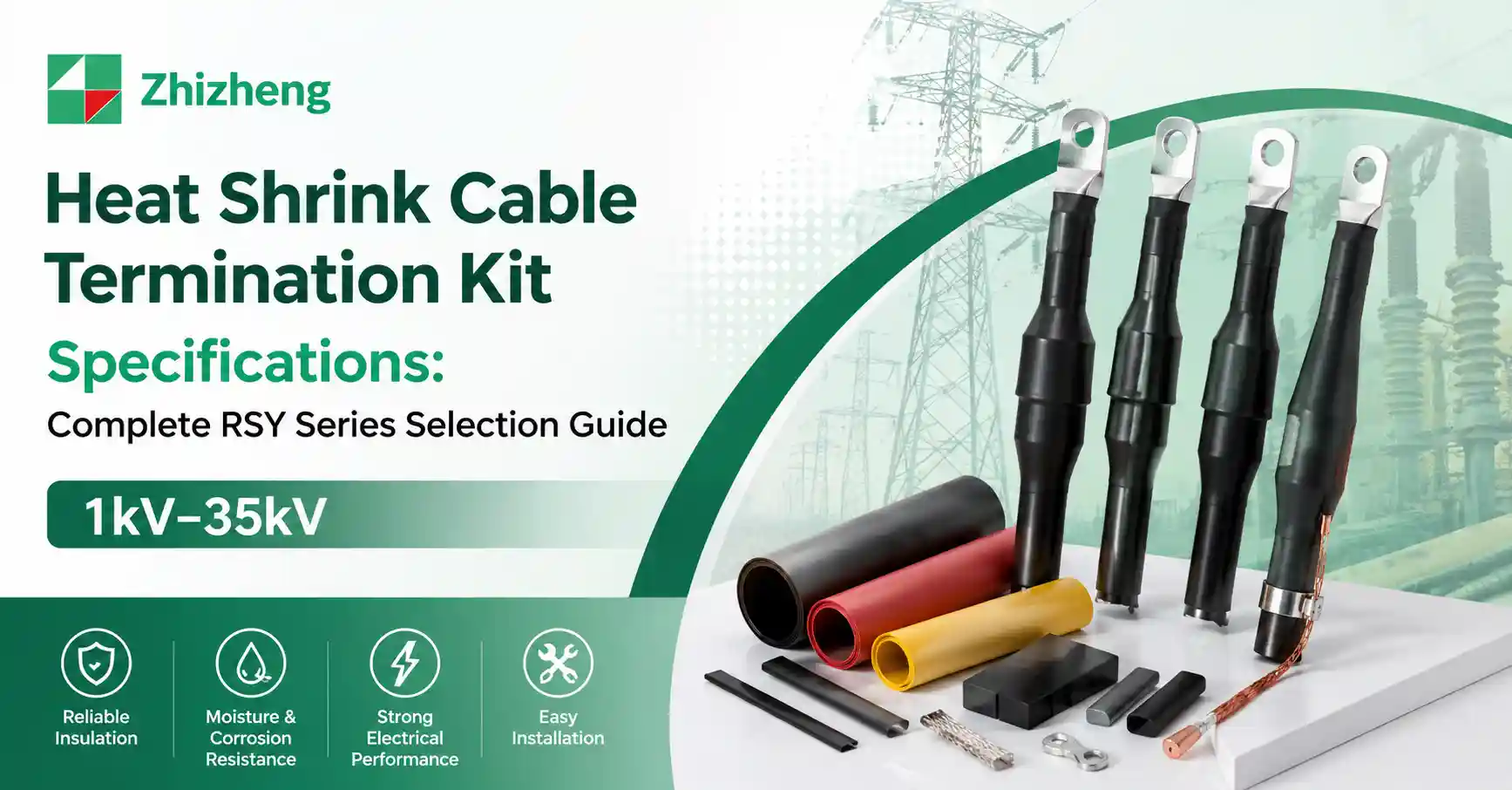
Heat Shrink Cable Termination Kit Specifications: Complete RSY Series Selection Guide (1kV–35kV)
2026-06-29 21:34
Mr. Xiao — Senior Technical Advisor, Zhizheng
20+ years in heat shrink cable accessory specification, sizing, and global project support. Based in Huangshi, Hubei, China.
? Table of Contents
Every week, our sales and technical team at Zhizheng receives enquiries that stall at the same point: the customer knows they need a heat shrink cable termination kit, they've confirmed the voltage level, but then the questions multiply. What conductor cross-section range does this kit cover? Does it work for both single-core and three-core cable? Is this the outdoor version or the indoor version? Are the cable lugs included or separate? Do we need a special tool?
These are not ignorant questions. Termination kit specification is genuinely complex, and the consequences of ordering the wrong kit on a time-critical project — re-procurement delays, mis-installation, rework costs — are significant. This guide is built to eliminate that confusion. By the end, you'll have the complete specification data for every heat shrink termination and joint kit in the Zhizheng RSY and JRSY series, a cable cross-section matching framework, a tool list, and a clear decision path for indoor vs. outdoor selection.
This is a decision-stage document. I'm going to be specific, because vague guidance doesn't help you place an order or write a BOM.
Why Specification Confusion Costs EPC Projects Real Money
I've spoken to procurement engineers who ordered 10kV termination kits for a 35kV distribution feeder because the project specification only said "MV cable accessories." I've also seen orders come in for single-core kits on three-core armoured cable because the electrical engineer specified by conductor cross-section alone without clarifying core count. Both scenarios require complete re-procurement, and on a project with a tight commissioning schedule, that delay cascades.
The practical reality is this: when selecting a cable termination kit, you must match the kit's voltage rating to your system voltage, confirm compatibility with your cable type (XLPE, EPR, or PILC), confirm the number of cores (single, three-core, or multi-core), and consider environmental conditions — using weather-resistant kits for outdoor use. Miss any one of those four parameters and you're ordering the wrong product.
Let's go through each parameter in turn, then map them to our specific products.
The Five Selection Parameters You Must Lock Down Before Ordering
Parameter 1: System Voltage (Uo/U)
This is the most fundamental selection criterion and the one most often mis-stated. The system voltage for cable accessory specification is expressed as Uo/U, where Uo is the phase-to-ground voltage and U is the phase-to-phase rated voltage. In the IEC convention used by most global markets:
6/10kV (Uo/U) — the standard 10kV distribution class in China, Europe, and much of Asia
18/30(35)kV — the standard 35kV class, also expressed as 26/35kV in some markets
0.6/1kV — the standard 1kV LV class
Always confirm with the project's single-line diagram or cable specification sheet. Specifying a 10kV kit on a 35kV circuit is not a marginal error — it is an insulation design failure waiting to happen.
Parameter 2: Cable Insulation Type
MV cable accessory products are designed for cables with round solid (RE), round stranded (RM), sector solid (SE), sector stranded (SM), and round stranded compacted (RMV) conductors for conductor temperatures up to 90°C. For heat shrink applications, the two dominant cable insulation types are XLPE (cross-linked polyethylene) and EPR (ethylene propylene rubber). Both are compatible with Zhizheng's RSY series. PVC-insulated cables at LV (RSY-1 applications) are also supported.
All conductor filling materials — tapes, yarn, powder, or similar — must be completely removed before installation. A check of the actual existing conductor dimensions by the user is indispensable.
Parameter 3: Cable Cross-Section (Conductor mm²)
The conductor cross-section (e.g., 95 mm²) is standardized and almost always printed on the cable jacket or listed in datasheets. However, cables with the exact same conductor can have vastly different insulation outer diameters depending on their voltage class and the manufacturer's design.
This is why cross-section alone is not sufficient for termination kit selection. You need the Diameter Over Insulation (DOC or DOI), which determines whether the heat shrink tube will achieve the required fit.
Parameter 4: Number of Cores
Single-core and three-core cables require fundamentally different termination geometries. Three-core termination kits include a breakout boot or crutch to fan the cores, plus three individual core termination tubes. Single-core kits cover one cable end. Single, three-core, or multi-core kits are available and must be matched to the actual cable construction.
Parameter 5: Installation Environment — Indoor or Outdoor
For terminations that will be exposed to direct precipitation, select the outdoor termination. Outdoor terminations include anti-tracking outer tubes, DSQ-type cable sheds for creepage distance extension, and UV-resistant formulations not required for indoor applications. Indoor terminations can be specified for most outdoor pad-mounted switchgear and transformer applications, since these enclosure interiors are protected from direct exposure to the elements — but confirm with your project engineer before making that substitution.
? Pro Tip — Confirm DOI Before You Order
The Diameter Over Insulation (DOI) appears as a range (e.g., "18–24 mm") in cable termination kit specifications. Select a kit where your calculated DOI falls within the stated range. When requesting a quote from our team, always provide the cable manufacturer's datasheet rather than estimating — manufacturer-to-manufacturer variation in insulation thickness can shift the DOI by 2–4 mm on the same conductor cross-section, which can change your kit size classification.
RSY Series Complete Specification Table (1kV / 10kV / 35kV)
The RSY series covers heat shrink cable termination kits from 1kV through 35kV. The following table provides the complete specification overview. For detailed conductor-specific DOI ranges, refer to Section 4 and to the individual product datasheets available on request.
| Model | Voltage Class (Uo/U) | Cable Type | Core Config. | Typical Conductor Range | Applicable Standard | Environment |
|---|---|---|---|---|---|---|
| RSY-1 | 0.6/1kV | XLPE / PVC | 1C / 3C / 4C / 5C | 16 mm² – 400 mm² | IEC 60502-1 | Indoor & Outdoor |
| RSY-10 | 6/10kV | XLPE / EPR | 1C / 3C | 25 mm² – 400 mm² | IEC 60502-2 / IEC 60502-4 | Indoor & Outdoor |
| RSY-35 | 26/35kV | XLPE / EPR | 1C / 3C | 50 mm² – 630 mm² | IEC 60502-2 / IEC 60502-4 | Indoor & Outdoor |
Note on voltage class naming: The designation "RSY-10" corresponds to the 6/10kV system class commonly used in China and internationally per the IEC convention. For European projects where the network is rated 8.7/15kV or 12/20kV, please confirm your system Uo/U with our technical team before ordering, as these fall between our standard RSY-10 and RSY-35 models. These kits conform to IEC 60502-4 and CENELEC HD 629.1, ensuring compatibility with utility and industrial standards for safety, performance, and durability.
Cable Cross-Section Matching Chart: Conductor mm² to Termination Kit
The following chart provides practical cross-section-to-kit matching guidance for standard XLPE cables. Always verify the exact diameter over insulation with your cable manufacturer before installing accessories. This table covers the most common conductor sizes encountered in power distribution and industrial projects.
| Conductor Cross-Section | Voltage Class | Approx. DOI Range (XLPE, IEC) | Zhizheng Kit Reference | Conductor Material |
|---|---|---|---|---|
| 16 – 70 mm² | 0.6/1kV | 12 – 22 mm | RSY-1 | Cu / Al |
| 95 – 400 mm² | 0.6/1kV | 22 – 42 mm | RSY-1 | Cu / Al |
| 25 – 95 mm² | 6/10kV | 18 – 26 mm | RSY-10 (Size 1) | Cu / Al |
| 120 – 240 mm² | 6/10kV | 26 – 36 mm | RSY-10 (Size 2) | Cu / Al |
| 300 – 400 mm² | 6/10kV | 36 – 46 mm | RSY-10 (Size 3) | Cu / Al |
| 50 – 150 mm² | 26/35kV | 26 – 38 mm | RSY-35 (Size 1) | Cu / Al |
| 185 – 400 mm² | 26/35kV | 38 – 54 mm | RSY-35 (Size 2) | Cu / Al |
| 500 – 630 mm² | 26/35kV | 54 – 70 mm | RSY-35 (Size 3) | Cu / Al |
⚠ Important: DOI ranges above are indicative for standard IEC-compliant XLPE cables. Actual insulation thickness varies by cable manufacturer and national standard. Always verify against cable manufacturer datasheet. IEC 60502-2 permits insulation thickness to be 10% below nominal, which reduces calculated DOI by approximately 10%. Request kit selection support from our engineering team by providing your cable datasheet.
? Practical Take — The Shrink Ratio Rule
When selecting the correct heat shrink tubing size, it is important to bear in mind the 80:20 rule. The heat shrink tubing must shrink by at least 20% and not more than 80% of its complete shrinkage capacity to achieve the right result. For power cable termination kits, this principle governs component-level tube sizing. A tube that has already shrunk to near its minimum recovered diameter under-performs on interface contact pressure. Our RSY kit components are engineered to land in the optimal 40–60% shrinkage range on standard cable insulation diameters, providing maximum contact pressure and minimal void risk at the stress relief interface.
JRSY Series: Heat Shrink Cable Joint Kit Specifications
When two cable runs need to be spliced together — either because the circuit exceeds drum length, or because a damaged section needs to be replaced — you need a heat shrink cable joint kit rather than a termination kit. The Zhizheng JRSY series covers 10kV and 35kV straight-through joints for XLPE and EPR cables.
| Model | Voltage Class | Joint Type | Core Config. | Conductor Range | Applicable Standard | Installation Env. |
|---|---|---|---|---|---|---|
| JRSY-10 | 6/10kV | Straight-through | 1C / 3C | 25 mm² – 400 mm² | IEC 60502-4 | Direct burial / Duct / Above-ground |
| JRSY-35 | 26/35kV | Straight-through | 1C / 3C | 50 mm² – 630 mm² | IEC 60502-4 | Direct burial / Duct / Above-ground |
Installing a heat shrinkable cable jointing kit is a critical task in ensuring safe, reliable, and long-lasting electrical connections. Whether you're working on low-voltage or medium-voltage cables, proper installation plays a major role in preventing faults, insulation failures, and costly downtime. The JRSY joint kit restores the full insulation, semi-conductive screening, and moisture-sealing integrity of the original cable construction at the joint point.
What's Inside the Kit: Component Breakdown by Voltage Class
One of the most common procurement questions I get is: "What exactly comes in the box, and do I need to order any additional components?" The answer depends on voltage class. Here is the component breakdown for the RSY termination series.
RSY-1 (1kV Termination Kit) — Typical Contents
Heat shrink crutch / breakout boot (for 3-core, 4-core, 5-core variants)
Heat shrink outer sheath tube (adhesive-lined)
Mastic sealing tape for sheath-to-boot transition
Installation instruction sheet
Cable lugs: Generally not included in the standard 1kV kit — compression or mechanical lugs ordered separately based on conductor material and crimping tool type. Lugs are generally not included in the standard kits to offer you the flexibility to choose between compression or mechanical lugs.
RSY-10 (10kV Termination Kit) — Typical Contents
Semiconductive stress control tube (dual-wall, with stress grading compound)
Insulating heat shrink tube (cross-linked polyolefin, irradiation cross-linked)
Anti-tracking outer insulation tube (UV-resistant, outdoor variants)
Heat shrink breakout boot / crutch (3-core variants)
Stress grading mastic tape
Moisture sealing mastic tape (for sheath and conductor entry points)
Constant force earthing spring or copper earth braid (screen bonding)
Cleaning pads / IPA wipes
Installation instruction sheet (with dimensional templates)
The kit includes all materials to carry out either 3 single-core or 1 three-core termination, except the main conductor phase lug.
RSY-35 (35kV Termination Kit) — Typical Contents
Semiconductive stress control tube (precision geometry for 35kV stress field management)
High-voltage insulating heat shrink tube (thick wall, irradiation cross-linked)
Anti-tracking outer tube (extended length for 35kV creepage requirements)
DSQ heat shrink cable sheds (for outdoor installations requiring extended creepage)
Heat shrink breakout boot with mastic sealing (3-core variants)
Stress grading mastic tape
Moisture sealing mastic tape — multiple lengths
Copper earth braid (screen continuity bonding)
Cleaning pads and surface preparation materials
Dimensional template and installation instruction sheet
? Pro Tip — Cable Lugs: Order Separately and Early
Cable lugs are almost never included in heat shrink termination kits at any voltage class. This is intentional — the lug barrel diameter must match the exact conductor cross-section and material (copper or aluminium), and the crimping tool compatibility further constrains lug selection. At Zhizheng, we supply tinned copper cable lugs (TCL series) and mechanical shear bolt lugs (BLMT series) as complementary products. When ordering RSY termination kits, identify your lug requirement at the same time and specify it as a separate line item on your purchase order to avoid a two-stage delivery delay.
Installation Tools Required: What to Have on Site Before You Start
I'll separate this into two categories: tools that must be on site before installation begins, and tools that are common to all voltage classes versus those specific to MV/HV work.
Universal Tools (All Voltage Classes)
Heat source:
Professional heat shrink gas torch kits should meet a high standard for carrying out professional heat shrinking work on low, medium, and high voltage cable installations — including the application of heat to thin, medium, and thick wall heat shrink tubes and components such as cable breakouts. For site work where mains power is unavailable,
a battery-powered heat gun is the best option, or a butane or propane torch.
Avoiding overheating:
To avoid overheating and blister damage, adjust the gas torch to obtain a soft blue flame with a yellow tip. Pencil-like blue flames should be avoided when jointing and terminating cables. Keep the flame moving continuously to avoid scorching the heat shrink material.
Cable knife / stripping tool: A correctly calibrated stripping tool matched to your cable insulation thickness. Avoid scoring the XLPE insulation surface during semi-con removal.
Crimping tool: Hydraulic or mechanical, matched to lug barrel bore and conductor cross-section. Die selection is conductor-material-specific (Cu vs. Al).
Steel tape measure and installation template: Precision cutting lengths are critical on MV/HV terminations. Use the dimensional template provided in the kit.
Cleaning materials: IPA (isopropyl alcohol) wipes or equivalent solvent-free cleaning pads.
Clean the exposed area with an alcohol wipe or dry cloth to remove dirt, grease, and moisture.
Vernier caliper or OD tape: To verify cable DOI before beginning and confirm correct kit size.
Additional Tools for MV/HV Work (RSY-10 and RSY-35)
Semiconductive screen removal tool / glass scraper: For controlled removal of the bonded semiconductive screen — cutting into the XLPE insulation during this step is the single most common preparation error at 10kV and 35kV.
Portable partial discharge tester (recommended): For post-installation verification before energisation. Not a mandatory tool, but strongly advised on utility-grade and industrial MV circuits.
Earth bonding materials: Copper tape, compression connectors, or constant force springs for screen earthing (typically included in the kit, but confirm).
Portable dehumidifier or wind barrier: For outdoor installations in high-humidity environments. Maintaining relative humidity below 70% at the work zone during heat shrink application is important for consistent seal quality.
| Tool | RSY-1 (1kV) | RSY-10 (10kV) | RSY-35 (35kV) |
|---|---|---|---|
| LPG torch or industrial heat gun | ✅ Required | ✅ Required | ✅ Required |
| Cable knife / precision stripper | ✅ Required | ✅ Required | ✅ Required |
| Crimping tool (hydraulic or mechanical) | ✅ Required | ✅ Required | ✅ Required |
| Vernier caliper / OD tape | Recommended | ✅ Required | ✅ Required |
| Semiconductive screen removal tool | — | ✅ Required | ✅ Required |
| IPA cleaning pads | ✅ Required | ✅ Required | ✅ Required |
| Earth bonding materials | — | ✅ (In kit) | ✅ (In kit) |
| Portable PD tester | — | Strongly advised | Strongly advised |
| Dimensional template (in kit) | ✅ (In kit) | ✅ (In kit) | ✅ (In kit) |
Indoor vs. Outdoor: How to Specify the Right Variant
This is a selection step that gets glossed over on many projects. The distinction matters technically, not just nomenclature-wise.
Indoor terminations are designed for installation inside metal-enclosed switchgear, transformer terminal boxes, cable junction boxes, and enclosures that protect the termination from direct exposure to precipitation and UV radiation. The outer tube may not include anti-tracking formulation, and no cable sheds are fitted.
Outdoor terminations must manage surface tracking and weathering. UV-resistant, non-tracking outer tubes ensure long life even under adverse conditions. Outdoor RSY-35 configurations include our DSQ heat shrink cable sheds to achieve the required creepage distance for the installation's pollution severity class per IEC 60815.
The general decision rule is straightforward:
If the cable terminates inside a metal enclosure rated IP34 or better → indoor kit
If the cable terminates on an outdoor pole, wall bracket, or open-air busbar → outdoor kit with sheds
Indoor terminations can be specified for most outdoor pad-mounted switchgear and transformer applications, since these enclosure interiors are protected from direct exposure to the elements — confirm with your project engineer
In polluted or coastal environments, upgrade to outdoor termination even when nominally "indoor" installation is used in open-fronted housings
? Practical Take — Pollution Severity Class
For outdoor RSY-35 installations in coastal or high-pollution industrial environments (IEC 60815 Pollution Severity Class III or IV), the standard DSQ shed configuration may need to be extended with additional shed rings to achieve the required specific creepage distance (typically 25–31 mm/kV for Class III, 31 mm/kV for Class IV). Contact our technical team with your site pollution class classification when ordering outdoor 35kV terminations — we will confirm whether the standard shed count is sufficient or supply extended creepage configurations.
Common Ordering Mistakes and How to Avoid Them
After reviewing hundreds of project enquiries over the years, these are the ordering mistakes that come up most often. They're worth running through before you finalize your BOM.
Mistake 1: Specifying by Voltage Level Only, Not Uo/U
Stating "35kV termination kit" without specifying whether the system is 26/35kV or 19/33kV creates ambiguity that can result in an incorrect kit. Always specify the full Uo/U designation from your project's cable specification sheet.
Mistake 2: Confusing Cable Cross-Section with Kit Size
RSY kit "Size 1", "Size 2", and "Size 3" classifications correspond to DOI (Diameter Over Insulation) ranges, not directly to conductor cross-section mm². At 35kV, the same 185 mm² conductor in an EPR cable may have a larger DOI than in an XLPE cable, requiring a different kit size. Cables with the exact same conductor can have vastly different insulation outer diameters depending on their voltage class and the manufacturer's design.
Mistake 3: Ordering Indoor Kit for Outdoor Application
The visual similarity between indoor and outdoor heat shrink kits is deceptive. An indoor kit without anti-tracking outer tube and sheds will track and fail within a few years in an outdoor environment. Environmental conditions require using weather-resistant kits for outdoor use.
Mistake 4: Forgetting to Order Lugs
Termination kits do not include conductor lugs. Place your lug order at the same time as the kit order. On RSY-35 applications, specify copper or aluminium barrel lugs sized to the exact conductor mm² and compatible with your crimping tool die set.
Mistake 5: Not Confirming Screen Type Before Ordering
For 10kV and 35kV cables, the type of copper screen (copper wire screen, copper tape screen, or extruded semi-conductive screen with copper wire) affects the earthing arrangement within the termination kit. Different screen types require different earth bonding methods. Confirm screen type with your cable supplier before finalising the kit order.
Frequently Asked Questions
Q1: What information do I need to provide to get a confirmed RSY kit recommendation from Zhizheng?
To provide a confirmed kit recommendation, we need: (1) System voltage — full Uo/U designation; (2) Cable insulation type — XLPE, EPR, or PVC; (3) Conductor cross-section in mm², and conductor material (copper or aluminium); (4) Number of cores — single-core or three-core; (5) Installation environment — indoor, outdoor, or direct burial; (6) Cable manufacturer and type designation, or the cable datasheet with DOI (Diameter Over Insulation) data. If you can share the cable manufacturer's technical datasheet as a PDF, our team can complete the full selection and confirm the correct RSY size variant and any complementary components in one response. Send to: hszzjohnlee@aliyun.com
Q2: Can the RSY-10 termination kit be used on 8.7/15kV or 12/20kV cables that fall between the 10kV and 35kV voltage classes?
This is a question we receive regularly from European customers. The RSY-10 is designed and type-tested for the 6/10kV class per IEC conventions. For 8.7/15kV systems (common in the USA and some European markets) or 12/20kV systems, neither the RSY-10 nor the RSY-35 is a direct specification match without engineering confirmation. Please contact our technical team with your precise Uo/U data. We can confirm whether an RSY-10 variant with extended components can support 15kV class, or whether the RSY-35 is the correct minimum specification for your system. Never assume a kit rated at a lower voltage class provides adequate protection for a higher voltage system.
Q3: Are Zhizheng RSY termination kits compatible with both copper and aluminium conductor cables?
Yes. The heat shrink components of the RSY series (stress control tubes, insulating tubes, outer tubes, mastics) are compatible with both copper and aluminium conductor cables. The conductor material affects the lug selection (the lug barrel bore and crimp die must match the conductor material) but does not affect the compatibility of the heat shrink components themselves. For aluminium conductors at 10kV and 35kV, ensure the cable lugs ordered are aluminium-compatible and that anti-oxidant compound is applied at the conductor barrel before crimping, per standard practice for aluminium terminations.
Q4: What is the shelf life of Zhizheng RSY heat shrink termination kits, and what are the storage conditions?
Heat shrink termination kits should be stored in their original sealed packaging in a dry, UV-protected location, away from direct sunlight and sources of heat or ozone (such as electrical motors). Typical recommended storage temperature is 5°C to 35°C with relative humidity below 75% non-condensing. Under these conditions, shelf life is a minimum of 3 years from the manufacturing date. The mastic sealing tapes within the kit are the most storage-sensitive component — once exposed to air, mastic should be used promptly. For projects where kits will be stored on site for extended periods before installation, keep kits in sealed original packaging until the day of use and inspect mastic tapes for texture consistency before applying.
Q5: Can RSY termination kits handle sector-shaped conductors, which are common in older three-core cables?
One of the practical advantages of heat shrink technology is its ability to accommodate non-circular geometries. Heat shrink accessories cover numerous cable ranges and are not size-sensitive — they can be used on sector-shaped conductors. The mastic sealing tape fills the voids at the sector-shaped conductor interface, and the heat shrink tube conforms to the shape under heat application. For RSY-10 and RSY-35 applications on sector-shaped conductors, confirm the sector dimensions with our team so we can verify adequate mastic provision in the kit. On very old paper-insulated lead-covered (PILC) cables, additional compatibility considerations apply — contact us for guidance before ordering.
Ready to Finalize Your Heat Shrink Termination Kit Order?
Send us your cable datasheet and project voltage class. Our engineering team will confirm the correct RSY or JRSY kit, cable lug sizing, and any accessory components — with a formal product recommendation and quotation within 24 hours.
? #288 Zhongshan Road, Economic Development Zone, Huangshi City, Hubei, China | ? +86 187 72277521 | ? 0714-6351539
Mr. Xiao — Senior Technical Advisor
Hubei Zhizheng Rubber & Plastic New Material Corp., Ltd. | Huangshi, Hubei, China
Mr. Xiao has over 20 years of experience in heat shrink and cold shrink cable accessory specification, sizing engineering, and global project support. He routinely assists EPC contractors, electrical engineers, and procurement teams in Europe, the Middle East, Southeast Asia, and Latin America in finalising correct cable accessory specifications for power distribution, industrial, and renewable energy applications. Zhizheng has manufactured cable accessories from its Huangshi, Hubei facility since 1998 and exports to more than 30 countries worldwide.
References
VPTPL — "Heat Shrink Cable Termination Kits Complete Guide for 1.1kV to 36kV Power Systems." vptpl.com (July 2025)
TE Connectivity — Heat Shrinkable Outdoor Termination Kits (HVOT / IXSU Series). te.com (March 2026)
Power & Cables / Nexans — Medium Voltage Cable Accessories Catalogue: MV HV Heat Shrink Terminations. powerandcables.com
Industrial Monitor Direct — "Understanding Diameter Over Core Insulation for Cable Termination Selection Guide." industrialmonitordirect.com (April 2026)
Shrink Polymer Systems — Heat Shrink Cable Joints & Terminations LV HV (SPS Catalogue). slideshare.net
HellermannTyton — Heat Shrink Tubing Technical Information: Selection Guide & 80:20 Rule. hellermanntyton.co.uk
Power & Cables — "Heat Shrink Gas Torch Kits for Cable Jointers." powerandcables.com (September 2024)
PCA Technologies — "How to Install an Outdoor Termination Kit with Heat Shrink Components: Step-by-Step." pcatechnologies.com (June 2025)
Unique Cable Kits — "How to Install a Heat Shrinkable Cable Jointing Kit." uniquecablekits.com (April 2026)
ANHU Electric Power Group — "Cable Termination Kits Methods: Heat vs. Cold Shrink." anhu.group (June 2025)
Chardon Group — IEEE/ANSI Outdoor Cold Shrinkable Termination CSTO 15kV–35kV. chardongroup.com (March 2026)
Power & Cables / Nexans — 6–36kV Medium Voltage Underground Power Cables XLPE Technical Data. powerandcables.com
DSG-Canusa — Heat Shrink Medium Voltage Cable Terminations CT 3G Series. dsgcanusa.com
3M Electrical — Medium & High Voltage Cable Accessories FAQ. 3m.com
Hubei Zhizheng Rubber & Plastic New Material Corp., Ltd. — Company Profile, Product Catalogue & Certifications. hubeizhizheng.com (2026)