


35kV Heat Shrink Cable Joint Installation: Complete Field Guide for JRSY-35 (2026)
2026-05-01 09:57
35kV Heat Shrink Cable Joint Installation: A Complete Field Guide for JRSY-35 (2026)
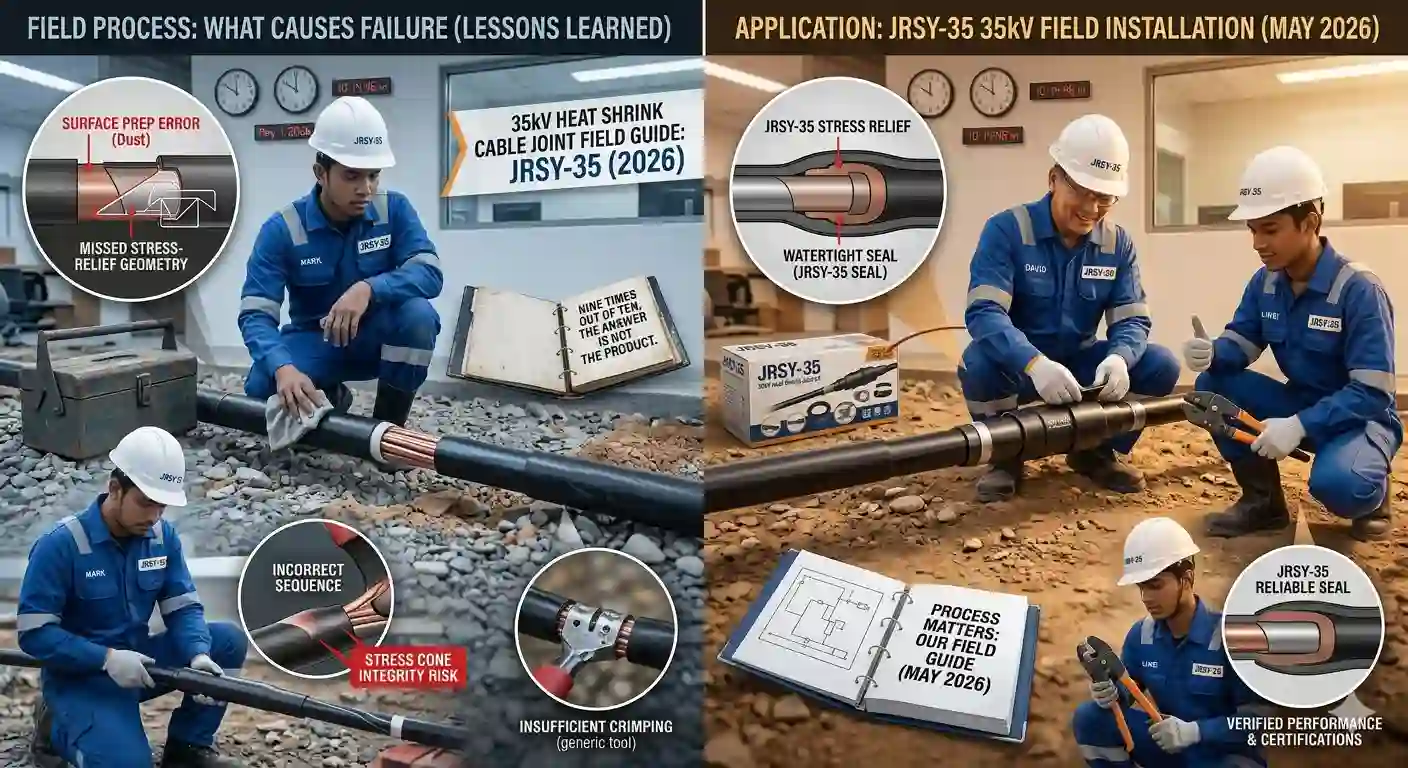
Let me be direct with you: a poorly installed 35kV heat shrink cable joint is not just a product failure — it is a safety incident waiting to happen. In over two decades of working with medium-voltage cable accessories, the most common question I get from utility engineers and project managers is not "which product should I choose?" It's "why did the joint fail six months after installation?"
Nine times out of ten, the answer has nothing to do with the product itself. It comes down to installation error — inadequate surface preparation, incorrect shrink sequence, missed stress-relief geometry, or insufficient conductor crimping. These are process failures, not material failures.
This guide is built around our JRSY-35 35kV Heat Shrink Cable Joint Kit — but the underlying principles apply to any heat shrink joint at this voltage class. I'm going to walk you through every critical stage, flag the mistakes I've seen in the field, and explain exactly why each step matters at the insulation and electrical level. If you're a technician preparing for your first 35kV joint, or a project manager trying to establish a reliable installation protocol, this is the reference you need.
1. Why 35kV Cable Joints Fail — And What It Really Costs
Medium-voltage cable joints operating at 35kV sit in a demanding electrical environment. The insulation system must manage not just bulk dielectric stress, but critically, the geometric stress concentration at the cable end — the point where the cable's semi-conductive screen is terminated and the electric field transitions from a uniform cylindrical distribution to a highly non-uniform one.
When that stress relief is compromised — whether through insufficient stress cone length, poor surface finish on the insulation, air voids between layers, or incorrect material compatibility — the result is partial discharge initiation. PD is slow. It can run for months before catastrophic breakdown. But it will always win eventually.
The cost of a single 35kV joint failure in a live distribution network is significant: emergency crew deployment, network downtime, potential equipment damage upstream, regulatory reporting requirements, and often, complete re-jointing of the cable section. In many markets we serve — Southeast Asia, the Middle East, Eastern Europe — a single avoidable failure can cost the project owner 15 to 40 times the original accessory cost in remediation.
I've seen this play out. That's why I take installation methodology seriously, and why Zhizheng invests heavily in technical documentation and field support alongside product development.
According to multiple grid operator maintenance reports, improper installation accounts for over 60% of premature medium-voltage cable accessory failures — significantly outweighing material defects or cable faults as the primary failure cause. At 35kV, this statistic is even more pronounced due to the higher electrical stress demands on the insulation interface.
2. Understanding the JRSY-35 Kit: Components & Design Logic
Before you can install a joint correctly, you need to understand what each component in the kit is actually doing electrically. The JRSY-35 is not just a collection of tubes and tape — it is an engineered insulation system where every layer serves a specific dielectric or mechanical function.
Key Components of the JRSY-35 Kit
Stress Control Tube (SCT): This is arguably the most critical component. Made from a precisely formulated semi-conductive material with a controlled resistivity profile, the SCT redistributes the electric field at the screen termination point, converting the dangerous field concentration into a gradual, manageable gradient. The shrink ratio and wall thickness are engineered so that after full recovery, it achieves intimate contact with the cable insulation surface — contact that is essential to its function.
High-Voltage Insulation Tube: Provides the primary bulk insulation across the joint body. Manufactured from cross-linked polyolefin (XLPO), it delivers excellent dielectric strength, tracking resistance, and long-term thermal stability up to the cable's rated operating temperature.
Semi-Conductive Screen Restoration Tube: Re-establishes the outer semi-conductive layer across the joint, ensuring the metallic screen continuity and field grading are maintained symmetrically on both cable sides.
Outer Protective Jacket Tube: The mechanical and environmental seal. Dual-wall construction with an internal adhesive lining provides waterproof, moisture-barrier sealing and mechanical abrasion resistance.
Copper Connector (Crimp Type): Joins the two cable conductors. Proper crimping is non-negotiable — a high-resistance crimp joint will cause localized heating that degrades the surrounding insulation system over time.
Self-Amalgamating Tape & Mastic: Used for profile building and void filling at transition regions. Applied correctly, they eliminate air pockets that would otherwise become PD sites.
The stress control tube must be slid onto the cable before crimping — this is obvious in theory, but in field conditions under time pressure, I have personally seen experienced crews forget this step and have to cut back and re-prepare. Always follow a written sequence checklist, not memory alone.
3. Pre-Installation Checklist: Tools, Conditions & Cable Verification
3.1 Environmental Conditions
Do not begin installation in the following conditions without mitigation measures:
Ambient temperature below 0°C or above 40°C — both extremes affect heat shrink recovery behavior and adhesive activation. If working in sub-zero conditions, pre-warm each tube in a controlled environment before sliding onto the cable. Do not use an open flame for pre-warming.
Relative humidity above 80% — moisture contamination of the insulation surface is one of the leading causes of interface tracking failures at 35kV. If working in wet or high-humidity conditions, erect temporary weatherproof sheltering over the joint area.
Presence of airborne dust, sand, or conductive particles — these will contaminate the prepared insulation surface and create PD initiation sites.
3.2 Required Tools
Calibrated hydraulic crimping tool — correct die size for the conductor cross-section (verify against connector specifications in JRSY-35 datasheet)
Semi-conductive screen removal tool or sharp knife with depth guide
Abrasive strip or paper (240-grit minimum) — for insulation surface preparation
Propane or MAPP gas torch with diffuser nozzle — never use a direct, focused flame
Clean lint-free cloths and cleaning solvent (isopropyl alcohol, ≥99% purity)
Tape measure, vernier caliper
Permanent marker for cut-dimension marking
Insulation resistance tester (minimum 5kV PI/DAR capable)
Phase continuity tester
3.3 Cable Verification Before Work Begins
Before cutting into a cable, verify the following:
Confirm the cable voltage class matches JRSY-35 rating (35kV / 26/35kV Ur)
Verify conductor cross-section falls within the kit's specified range
Confirm cable insulation type (XLPE or EPR — not PVC, which is not suitable for heat shrink joints at this voltage class)
Perform IR test on the cable section to confirm no pre-existing moisture ingress or insulation degradation
Confirm grounding: cable screens must be solidly grounded at both ends during work
4. Step-by-Step 35kV Heat Shrink Joint Installation
What follows is the installation sequence I use and teach. The exact dimensions (cut-back lengths, overlap distances) are specified in the JRSY-35 installation instruction sheet included with every kit — always read and follow that document. The process below explains the why behind each step, which is what turns a technician into a reliable installer.
Step 1: Cable Preparation — Outer Jacket Removal
Mark and remove the outer jacket to the specified length on both cable ends. Use a circumferential cut — never a longitudinal knife cut that risks nicking the metallic screen below. After jacket removal, clean the exposed area with isopropyl alcohol and inspect for mechanical damage to the screen wires or tape.
Step 2: Metallic Screen Cutback and Binding
Cut back the copper wire or tape screen to the dimension specified in the instruction sheet. This defines the length of the stress relief zone. Use copper tape to bind screen wire ends and prevent fraying. Apply mastic at the screen edge — this is your first line of defense against moisture ingress at a mechanically vulnerable point.
Step 3: Semi-Conductive Screen Removal
This step requires precision. The semi-conductive layer must be removed to a clean, sharp edge at the exact specified cutback dimension. Irregular removal — leaving traces of semi-conductive material on the XLPE insulation surface — will create localized resistivity discontinuities that generate PD. After removal, check for any embedded particles from the semi-conductive compound and remove them with abrasive strip.
The semi-con/insulation boundary must be a clean, square edge — not chamfered, not tapered. Chamfering is correct for cold shrink stress cones, but for heat shrink SCTs that use resistive field grading, a clean square edge is required to define the field control starting point accurately. Mixing techniques between product types is a common source of failure in the field.
Step 4: Insulation Surface Preparation
This is the most underestimated step in 35kV joint installation. Using 240-grit abrasive strip, lightly abrade the XLPE insulation surface in a circumferential motion to remove any surface oxidation, die-lubricant residues, or semi-conductive particles. After abrading, clean the entire insulation surface thoroughly with isopropyl alcohol. Allow to dry completely — this typically takes 2 to 3 minutes at ambient temperature.
The surface must be smooth, uniformly white (for black semi-con removal from XLPE), and absolutely free of contamination. Run a clean white cloth along the insulation — it should come back clean. If it doesn't, clean again.
Step 5: Pre-Position All Tubes on Cable Before Crimping
This is the step technicians most frequently skip or perform incorrectly under time pressure. Before making any connection, slide all heat shrink tubes and components that must pass over the conductor onto one cable end, in the correct order and orientation as specified by the instruction sheet. Once the conductor is crimped, you cannot pass tubes over the joint body.
Standard pre-positioning order for JRSY-35 (slide onto cable end A, check instruction sheet for your specific kit revision):
Outer protective jacket tube
Outer semi-conductive screen restoration tube
Main high-voltage insulation tube
Stress control tube (one per cable end)
Step 6: Conductor Connection — Crimping
Insert both cable conductors into the copper connector to the correct depth (verify with the mark on the connector). Use the calibrated hydraulic crimping tool with the correct die. Make the required number of crimps in the specified sequence (typically working from center outward). After crimping, file or grind any sharp protrusions from the crimp indentations — sharp points on a conductor surface at 35kV voltage class will cause localized field enhancement that eventually initiates insulation breakdown.
After filing, clean the connector and the adjacent insulation surfaces again with IPA. Do not use abrasive on the connector surface after filing — use clean cloth only.
Step 7: Stress Control Tube Application
Slide the stress control tube from the pre-positioned location on each cable end into its final position, centered over the semi-conductive screen edge with the specified overlap onto both the semi-con and the XLPE insulation. Apply heat using the gas torch with the diffuser nozzle, beginning at the center of the tube and working progressively toward each end. The tube should shrink uniformly and conform tightly to the insulation surface without trapped air bubbles. Do not overheat — excess heat can degrade the semi-conductive compound's resistivity profile, which is precisely calibrated at the factory.
Maintain the torch at 150–200mm from the tube surface. Use a slow, continuous rotating motion around the circumference — never hold the flame stationary. Observe the recovery: the tube should shrink progressively and smoothly, with adhesive appearing at the tube ends as a sign of full recovery and seal. Scorching or blistering indicates the flame is too close or moving too slowly.
Step 8: Mastic and Profile Building at Transition Zones
Apply mastic tape at the screen edge cutback positions to fill the step between the semi-conductive screen and the insulation. This profile building is essential: the insulation tube must recover over a smooth, void-free profile. Any abrupt step or air pocket under the insulation tube becomes a PD cavity. Build up the profile gradually, ensuring full circumferential coverage with no gaps or overlapping ridges.
Step 9: Main High-Voltage Insulation Tube Application
Slide the HV insulation tube to the centered position over the joint, ensuring the specified overlap onto the stress control tubes on both sides. Apply heat starting from the center, working outward symmetrically. The tube wall is thicker than the SCT, so take more time — a typical 35kV insulation tube requires 6 to 10 minutes for full recovery depending on ambient conditions. Confirm full recovery by checking that the tube profile follows the contour of the joint body without flat spots or bridging at the profile transitions.
Step 10: Screen Restoration and Outer Jacket Application
Apply the semi-conductive restoration tape or tube over the insulation tube, connecting the metallic screens from both cable ends through the joint body. Ensure solid electrical continuity — verify with a continuity tester. Then apply the outer protective jacket tube. For the jacket, heat application begins at one end and progresses to the other, allowing adhesive to flow out uniformly at the tube ends to confirm a complete environmental seal.
5. Six Critical Mistakes That Cause Premature Joint Failure
Based on failure analysis investigations and field audits conducted across projects in China, Southeast Asia, and the Middle East, here are the six installation errors I see most frequently at the 35kV level:
Contaminated insulation surface: Any oil, moisture, or conductive particle on the XLPE surface between the insulation tube and the cable compromises the interface. This is the single most common root cause of PD-induced failures in the first 12 months.
Incorrect stress control tube overlap: Both insufficient and excessive overlap onto the semi-conductive screen changes the electric field distribution from the designed profile. Measure and mark the position before shrinking.
Sharp burrs on crimped connector: The conductor connector sits at the center of the insulation tube — if it has sharp protrusions, it creates localized field enhancement even when fully surrounded by insulation. File smooth and re-clean.
Tubes not pre-positioned before crimping: Forces the crew to improvise, leading to missing components, incorrect sequence, or tubes installed in wrong orientation.
Over-heating or uneven heating of tubes: Causes asymmetric recovery, potential delamination between tube layers, or degradation of the semi-conductive compound's calibrated resistivity. Use a diffuser nozzle and keep the torch moving.
Skipping the post-installation insulation resistance test: A completed joint that has not been tested before re-energization is an unknown. Conduct the full post-installation test protocol before backfilling or energizing.
6. Heat Shrink vs. Cold Shrink at 35kV: Choosing the Right Solution
One of the most common questions I receive from project engineers is whether to specify heat shrink or cold shrink joints at 35kV. Both are valid — Zhizheng supplies both the JRSY-35 (heat shrink) and JLS-35 (cold shrink) for this voltage class — and the right choice depends on project-specific factors.
| Factor | Heat Shrink (JRSY-35) | Cold Shrink (JLS-35) |
|---|---|---|
| Installation Speed | Moderate — requires careful torch work | Faster — no heat source required |
| Confined Space Suitability | Requires ventilation for torch use | Excellent — no open flame |
| Cold Climate Performance | Good — torch heat not affected by ambient | Requires silicone-grade cold shrink rated for low temp |
| Material Cost | Generally lower | Generally higher |
| Skill Requirement | Higher — torch technique critical | Lower — no heat variable |
| Dielectric Performance | Excellent — when correctly installed | Excellent — silicone provides high flexibility |
| Certifications (Zhizheng) | ISO 9001, UL, SGS, Type Test 35kV | ISO 9001, UL, SGS, Type Test 35kV |
| Best Suited For | Open trench, overhead, well-ventilated substations | Manholes, tunnels, ATEX-rated zones, rapid deployment |
For the majority of open-trench 35kV distribution network jointing projects, the JRSY-35 heat shrink solution offers an excellent combination of dielectric performance, cost-effectiveness, and proven field reliability — provided that installation is carried out by trained personnel following the correct procedure.
7. Post-Installation Testing Protocol
A heat shrink cable joint is not complete at the moment the last tube is applied. It is complete when it has passed the post-installation electrical verification. Do not skip this, and do not allow project schedule pressure to bypass it. Catching a defective installation now costs you one re-jointing. Missing it costs you a network fault, emergency response, and potential safety incident.
7.1 Insulation Resistance Test
Using a 5kV DC insulation resistance tester, measure IR between each phase conductor and the metallic screen (earth). Record readings at 1-minute intervals for 10 minutes. Calculate the Polarization Index (PI = IR at 10 min / IR at 1 min). For a correctly installed 35kV XLPE cable joint, PI should exceed 2.0 and absolute IR values should be in the GΩ range. Values significantly below this range — or IR that decreases over the test duration — indicate moisture ingress or a contaminated interface. Investigate before energizing.
7.2 Phase Continuity and Screen Continuity Verification
Verify conductor continuity on all three phases with a low-resistance continuity tester. Measure screen continuity across the joint to confirm the screen restoration layer is properly connected. Any resistance anomaly on the screen path indicates incomplete screen connection, which will cause capacitive charge accumulation during operation.
7.3 High-Voltage Withstand Test (Where Specified)
Some utility standards require a post-installation AC or DC withstand test on jointed cable sections. Follow the project specification and the cable manufacturer's rated test voltage guidance. Do not apply test voltages that exceed the cable or accessory rated withstand levels.
Record all installation parameters: technician name, date, ambient temperature and humidity, cable details, connector size and crimp die number, and all test results. Photograph each key installation stage. This documentation is your quality assurance record and your first reference if any issue arises later. Zhizheng can provide installation record templates on request — contact us at hszzjohnlee@aliyun.com.
8. Frequently Asked Questions
IEC 60502-4:2010 — Power cables with extruded insulation and their accessories for rated voltages from 1 kV (Um = 1.2 kV) up to 30 kV (Um = 36 kV) — Part 4: Test requirements on accessories for cables with rated voltages from 6 kV (Um = 7.2 kV) up to 30 kV (Um = 36 kV)
IEEE 404-2012 — Standard for Extruded and Laminated Dielectric Shielded Cable Joints Rated 2500 V to 500 000 V
IEC 60060-1:2010 — High-voltage test techniques — Part 1: General definitions and test requirements
GB/T 11017 (Chinese National Standard) — Cross-linked polyethylene insulated power cable series
Hubei Zhizheng Rubber & Plastic New Material Corp., Ltd. — JRSY-35 Product Datasheet & Installation Manual (2026 Edition). Available at: www.hubeizhizheng.com
Zhizheng Quality Certifications: ISO 9001:2015, ISO 14001:2015, OHSAS 18001:2007, IATF 16949, UL, SGS, REACH, RoHS (Certificate records on file, available on request)