


Underground Cable Accessories Selection: A Practical Guide for Direct Burial & MV Cable Joints (2026)
2026-06-29 21:56
Underground Cable Accessories Selection: A Practical Guide for Direct Burial and MV Cable Joints
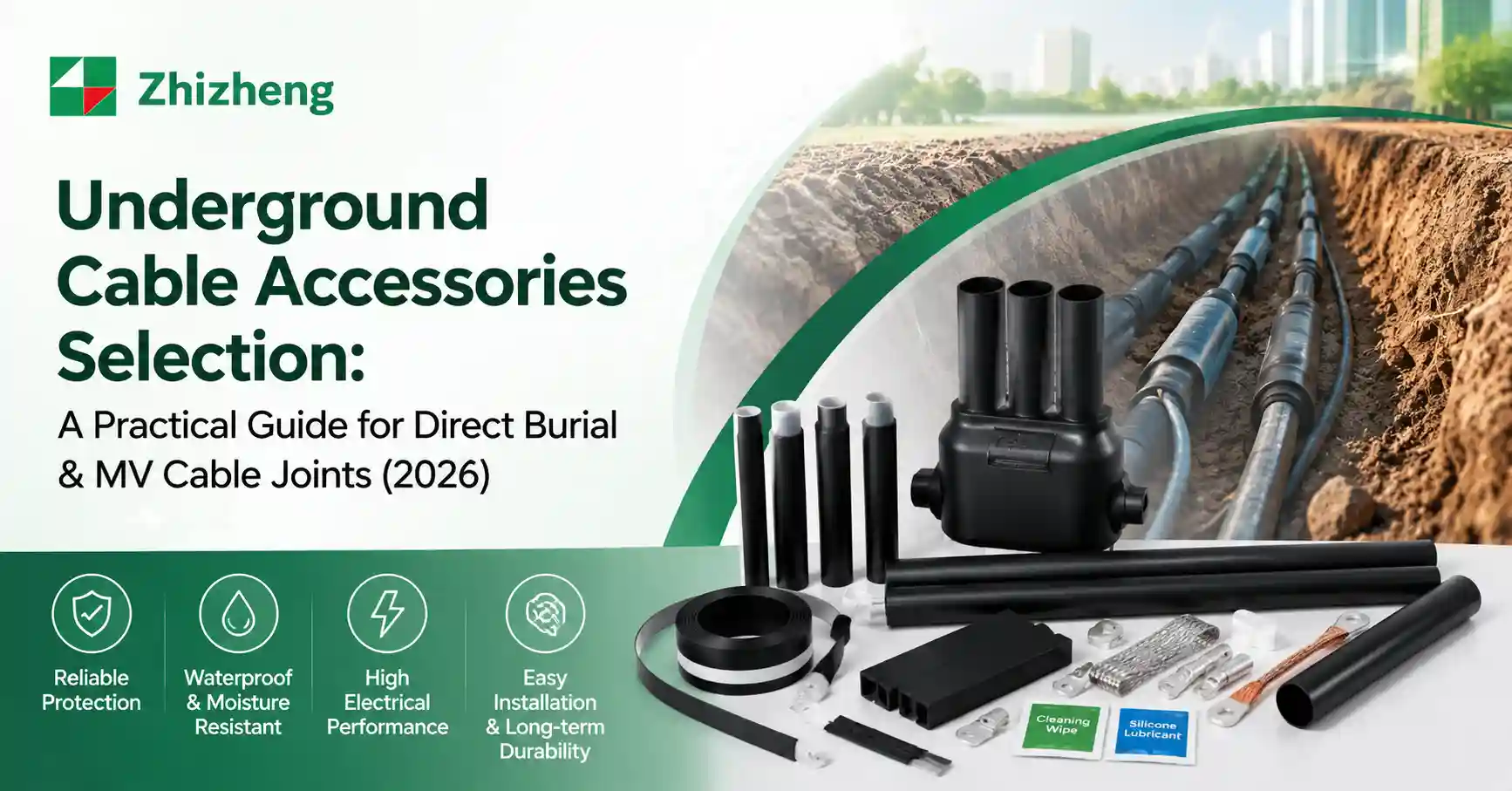
I have been in the cable accessories business for over two decades. In that time, I've watched a clear pattern repeat itself across Southeast Asia, Africa, the Middle East, and South America: a city grows fast, the overhead grid gets messy, and eventually someone decides to push the distribution network underground. That decision is almost always the right one. But the next decision — which accessories to use once everything is buried — is where projects either hold up or fall apart five years later.
This guide is written specifically for distribution network planning engineers and underground cable project contractors working in urbanizing regions. If you are already past the "should we go underground?" question and are now asking "what cable accessories do we actually need to make this work?", you are in the right place.
Why Underground Cable Networks Are Expanding in Developing Regions
The trend is structural, not cyclical. Between 2020 and 2026, dozens of national grid operators across Sub-Saharan Africa, South and Southeast Asia, and Latin America have formalized underground distribution programs — driven partly by climate resilience goals (overhead lines are catastrophically vulnerable to typhoons, ice storms, and sand erosion), and partly by the sheer pressure of urban density. You simply cannot run enough overhead infrastructure into a city of five million people growing at 4% per year.
What this means practically is that more engineers and contractors than ever before are making underground cable accessory decisions for the first time, often without the institutional knowledge that more mature grid operators have built up over decades. The stakes are high: a poorly selected underground MV cable joint buried under a city street can take weeks and significant cost to replace, and can result in a distribution outage affecting thousands of customers.
This is not a situation where the cheapest accessory on the procurement list is the right answer.
The Real Threats to Underground Cable Accessories
Before you can make a good selection decision, you need to understand what underground environments actually do to cable accessories. In my experience, engineers coming from an overhead line background often underestimate how different the underground environment is.
Moisture and Water Ingress
This is the number one cause of premature failure in underground cable accessories globally. Water does not need a large opening to cause damage — capillary action will draw moisture into even microscopic gaps between the accessory and the cable insulation over time. In humid tropical regions, soil moisture levels can stay high year-round. In areas with seasonal flooding or high groundwater, the accessory may be periodically submerged. Any accessory that does not form a genuine hermetic seal with the cable insulation will eventually fail electrically.
Soil Corrosion
Soil chemistry varies enormously. Coastal areas, reclaimed land, and industrial zones often have acidic or saline soils that aggressively corrode metal components. The outer sheath of the accessory and any metallic fittings need to be rated for the specific soil conditions of the project site. This is a detail that often gets skipped in the accessory specification process, and it should not be.
Mechanical Stress from Soil Movement
Underground cable joints are rigid by design, but the surrounding soil is not. Thermal cycling of the cable causes expansion and contraction; soil settlement (common in newly developed areas) applies longitudinal and transverse forces to the joint. The connection between the accessory and the cable needs to accommodate a degree of mechanical flexibility without losing its seal integrity.
Thermal Load in Confined Spaces
In conduit or duct installations, heat dissipation is restricted. A cable running at high load in a conduit can reach higher sustained temperatures than the same cable in direct burial. Accessory materials must retain their properties across the full operating temperature range without creep or seal degradation.
Underground Threat Assessment by Installation Scenario
| Threat Factor | Direct Burial | Conduit / Duct | Flooded Trench | Critical Accessory Property |
|---|---|---|---|---|
| Water / moisture ingress | High | Medium | Very High | Hermetic seal, dual-wall construction |
| Soil corrosion | High | Low | High | Corrosion-resistant outer jacket |
| Mechanical soil movement | High | Low | Medium | Flexible seal zone, anti-pull design |
| Thermal load retention | Medium | High | Medium | High-temp rated materials, no creep |
| UV / ozone exposure | None | None | None | N/A for fully underground |
Heat Shrink vs. Cold Shrink for Underground Applications
This is a question I get asked regularly, and the honest answer is that both technologies can work well underground — provided they are correctly specified and correctly installed. But there are meaningful differences worth understanding.
Heat shrink cable accessories use a cross-linked polymer that has been expanded and "locked" in an expanded state. When heat is applied during installation, the memory of the polymer is released and the tubing contracts tightly around the cable. This creates a mechanically strong, pressure-consistent seal that conforms precisely to the cable geometry. The shrink process also activates hot-melt adhesive lining (in dual-wall products), which bonds the accessory to the cable jacket and creates a genuine waterproof barrier.
The key advantage underground: once installed, a heat shrink accessory is essentially passive. There are no pre-loaded spring forces, no stored mechanical energy, and no materials that relax over time. This stability is particularly valuable in applications where the accessory will be inaccessible for years or decades.
Cold shrink accessories use pre-expanded silicone or EPDM rubber that contracts when the internal support core is removed during installation. Cold shrink is faster to install (no torch or heat gun required) and is excellent in spaces where open flame is not permitted. However, the contraction force of cold shrink relies on the ongoing elastic energy stored in the rubber. Over very long service lives in high-temperature underground environments, this matters.
For underground MV cable joints and direct burial cable terminations in developing-region projects — where service life expectations are long, maintenance access is difficult, and site conditions at installation time may include humidity and high ambient temperatures — high-quality heat shrink accessories with hot-melt adhesive sealing represent a highly reliable choice, particularly for voltage levels from 1kV through 35kV.
On projects where installation crews are working across multiple sites with variable skill levels, I tend to recommend heat shrink — not because cold shrink is inferior, but because heat shrink installation quality is more visible and verifiable. You can see whether the adhesive has flowed properly and whether the shrink is complete. With cold shrink, an improperly removed core can leave stress concentrations that are invisible until failure. For projects where you are training local crews, heat shrink gives you better quality control in the field.
Key Performance Criteria When Selecting Underground Accessories
When I review a specification for underground cable accessories, these are the criteria I check first:
Voltage class compatibility: The accessory must be rated for the highest operating voltage of the circuit, including transient overvoltages. For MV distribution systems, this typically means 10kV, 15kV, or 35kV class accessories with appropriate insulation levels.
Cable cross-section range: The accessory must accommodate the actual conductor cross-sections being used. Using a wide-range kit on a cable at the extreme edge of its range compromises seal quality.
Ingress protection rating: Look for accessories specifically rated and tested for submersion or continuous water exposure. IP68 testing or equivalent waterproof testing certification is the standard to ask for.
Material certification: UL, SGS, and compliance with IEC standards (IEC 60502, IEC 60229) confirm that the materials meet defined performance thresholds. Do not accept accessories that cannot provide test documentation.
Anti-tracking performance: In humid soils, surface tracking along the insulation interface is a real failure mode. Anti-tracking materials in the insulation and stress-relief zones are essential for MV applications.
Quality system certification: ISO 9001:2015 certification confirms that the manufacturing process is controlled and consistent — not just that a single sample passed a test.
Zhizheng Heat Shrink Cable Accessories for Underground Use
Zhizheng has been manufacturing heat shrink cable accessories since 1998, with our base in Huangshi Economic and Technological Development Zone, Hubei Province. Our production system covers the full process — extrusion, irradiation cross-linking, heat expansion — in a 40,000 m² integrated facility. This matters for underground applications because material consistency across production batches directly affects seal reliability over a 20-30 year service life.
Our products are exported to more than 30 countries, with significant presence in developing-region power infrastructure projects. Here is how our heat shrink cable accessory lineup maps to underground application requirements:
Heat Shrink Cable Termination Kits (Underground Outdoor/Indoor & Direct Burial)
RSY-35 — 35kV Heat Shrink Cable Termination Kit: For medium-voltage distribution at 35kV. The stress control tube, insulation tube, and outer sealing tube are engineered to work as a system, providing reliable electrical stress management and moisture exclusion at cable ends. Suitable for both conduit pull-through and direct burial termination scenarios.
RSY-10 — 10kV Heat Shrink Cable Termination Kit: Our most widely deployed product for urban underground distribution networks. 10kV is the dominant distribution voltage in many Asian and African urban grids. This kit is designed for ease of field installation while maintaining the sealing performance required in humid, wet underground environments.
RSY-1 — 1kV Heat Shrink Cable Termination Kit: For low-voltage secondary distribution. These are commonly used in urban residential and commercial distribution boxes that are installed in underground enclosures or partially buried structures.
Heat Shrink Cable Joint Kits (Underground MV Cable Joint)
JRSY-35 — 35kV Heat Shrink Cable Joint Kit: This is the product for the most demanding underground MV cable joint applications. The joint kit provides full insulation restoration, metallic shielding continuity, and outer jacket sealing. At 35kV, correct installation of the semi-conductive stress relief and the insulation body is critical — our documentation and technical support are designed to guide installation teams through each step.
JRSY-10 — 10kV Heat Shrink Cable Joint Kit: Designed for direct burial and conduit installation of 10kV XLPE distribution cables. The hot-melt adhesive-lined outer sealing tubes form a waterproof barrier that protects the joint from groundwater and soil moisture ingress under sustained submersion conditions.
Supporting Components for Underground Applications
HDW Dual Wall Semiconductive Tubing: Used in the stress control zone of MV accessories to manage the electric field gradient at the cable insulation cut end. Cross-linked dual-wall construction provides both semiconductive function and adhesive sealing in one tube.
Anti-Tracking Heat Shrink Insulation Tubing: Formulated with tracking-resistant materials for outdoor and underground-exposed applications where surface conductivity from contamination and moisture is a concern.
Medium Wall Heat Shrink Tubing: General-purpose insulation and jacketing with wall thickness suited to mechanical protection in underground environments.
Certifications Relevant to Underground Specification
Our products hold ISO 9001:2015 quality management certification, ISO 14001:2015 environmental management certification, IATF 16949 for automotive harness applications, and UL certification. We also hold SGS REACH and RoHS compliance certificates and a Type Test Report for our 35kV Cold Shrink Cable Accessories. The National High-Tech Enterprise certificate reflects ongoing investment in materials research and process development.
Direct Burial vs. Conduit: How Installation Method Changes Your Selection
I see these two scenarios treated as interchangeable on project specifications, and they should not be. The differences matter for accessory selection.
Direct burial means the accessory is in direct contact with soil. This maximizes exposure to soil moisture, corrosive chemicals, and mechanical stress from settlement and root intrusion. For direct burial cable terminations and joints, the outer sealing system of the accessory must be rated for direct soil contact. The outer protection tube or jacket should be evaluated for UV resistance (if any portion is above grade), chemical resistance, and mechanical toughness. Backfill quality around the joint is also a factor — the accessory specification should note whether protective slabbing or marker tape is required.
Conduit or duct installation provides mechanical protection but creates its own challenges. The conduit may fill with water — in fact, in most tropical climates, you should design on the assumption that any conduit system will eventually contain water at some point. This means waterproof accessory selection remains important even in conduit. Additionally, conduit restricts heat dissipation, so thermal performance of the accessory materials matters more. Cable pulling tension also applies mechanical stress to joints installed in conduits — the accessory should be dimensioned and installed to handle this.
One of the most common failure points I have seen in urban underground networks is not the joint itself, but the transition where the cable exits the conduit end into a manhole or junction box. This transition is often left exposed to standing water and condensation. Make sure to specify outer sealing tubes that extend beyond the conduit end and bond properly to the cable outer jacket at this point. A heat shrink breakout boot with adhesive lining is often the right product here.
Common Mistakes Contractors Make with Underground MV Cable Joint Selection
Based on what I have seen across the industry over 20 years, these are the most frequent mistakes:
Selecting based on initial price alone. Underground cable joints are maintenance-intensive to replace. The cost of one excavation and repair event in an urban area typically exceeds the total cost of the accessories for an entire project. Saving 15% on accessory cost is not worthwhile if it increases failure probability.
Using accessories not rated for the actual installation condition. An accessory rated for "indoor" or "above-grade outdoor" installation is not the same as one rated for direct burial or permanent submersion. This distinction must be verified in the product datasheet, not assumed.
Ignoring cable cross-section range compatibility. Heat shrink accessories are typically rated for a range of conductor sizes. Using a product at the extremes of its stated range — particularly the small end — can result in insufficient shrinkage and poor sealing.
Inconsistent installation quality across crew shifts. An underground MV cable joint is only as good as the installation. Projects that invest in product quality but skip installation training for local crews are common. Technical documentation and installation support from the supplier matters — make sure your supplier provides it.
Not verifying material compliance for the specific soil environment. Standard product certifications may not cover all soil chemistry conditions. For aggressive saline or acidic soil environments, specifically verify outer jacket material compatibility.
Frequently Asked Questions
IEC 60502-4:2010 — Power cables with extruded insulation and their accessories for rated voltages from 1 kV up to 30 kV — Part 4: Test requirements on accessories for cables with rated voltages from 6 kV to 30 kV
IEC 60229:2007 — Tests on cable oversheaths which have a special protective function
ISO 9001:2015 — Quality management systems — Requirements (Zhizheng certified)
IATF 16949:2016 — Quality management system requirements for automotive production and relevant service part organizations (Zhizheng certified 2019)
UL 486A-486B — Wire Connectors — Standard for Safety (Zhizheng UL certified product line)
Hubei Zhizheng Rubber & Plastic New Material Corp., Ltd. — Product Technical Documentation, 2025–2026. www.hubeizhizheng.com
World Bank Urban Development Reports, 2023–2025 — Urbanization trends and power infrastructure investment in developing economies