



Heat Shrink Cable Accessories: The Complete Guide to Types, Working Principles & Selection (2026)
2026-03-30 22:27
Senior Technical Engineer · Hubei Zhizheng Rubber & Plastic New Material Corp., Ltd.
Published: 2026 · Reading time: 18 min
I've spent over a decade inside factories where heat shrink cable accessories are made — from the raw polyolefin compound extrusion all the way through electron-beam cross-linking and final expansion. Over the years, I've answered hundreds of technical questions from power engineers and distributors across North America, the Middle East, and Southeast Asia. The most common one? "What exactly should I know before I purchase heat shrink cable accessories?"
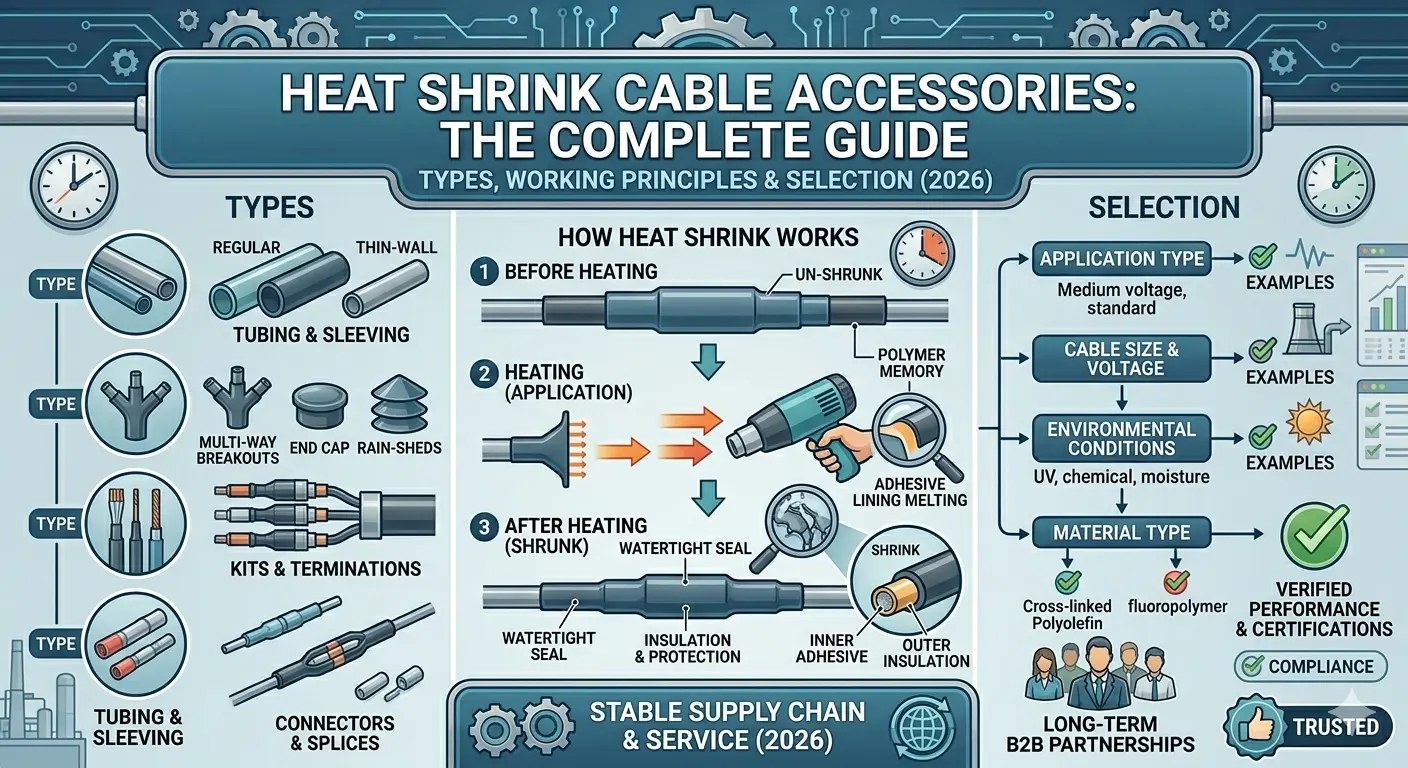
This guide is my attempt to answer that question once and for all. Whether you're specifying cable accessories for a 10 kV distribution network or evaluating suppliers for a 35 kV substation upgrade, this article covers everything from fundamental definitions and working principles to classification, applications, and practical selection criteria.
Let's get into it.
? Table of Contents
1. What Are Heat Shrink Cable Accessories?
If you strip back an underground power cable at a joint or termination point, you'll find the most vulnerable part of any cable network — the exposed interface between cable insulation, semiconductive screen, metallic sheath, and the outside environment. That interface needs to be reconstructed with the same electrical and mechanical integrity as the original cable. Heat shrink cable accessories do exactly that.
In plain terms, heat shrink cable accessories are pre-engineered kits of cross-linked polymer components — tubes, stress control elements, insulation layers, sealing mastics, and mechanical hardware — designed to insulate, seal, and protect cable termination points and cable-to-cable joints. When heated by an industrial heat gun or propane torch, these specially expanded polymer components shrink uniformly around the cable, creating a tight, void-free seal that restores the cable system's dielectric, mechanical, and environmental protection.
This category includes two primary product families:
Heat shrink cable termination kits — used to seal and insulate the open ends of power cables at switchgear, transformers, poles, or equipment bushings.
Heat shrink cable joint kits — used to connect two cable lengths together while maintaining full electrical and mechanical integrity through the splice.
And within those families, you'll find an ecosystem of individual components — stress control tubing, semiconductive tubing, anti-tracking insulation tubes, breakout boots, and cable sheds — each serving a specific electrical function inside the assembly.
2. How Do Heat Shrink Cable Accessories Work?
I get this question a lot from procurement engineers who are responsible for purchasing decisions but didn't come from a cable jointing background. So I'll explain it the way I would over coffee — no textbook jargon.
2.1 The Cross-Linking & Expansion Process
It all starts in the factory. We extrude polyolefin-based compounds (typically cross-linked polyethylene or EVA blends) into tubes, then pass them through an electron-beam irradiation process. This cross-links the polymer chains at the molecular level, creating a "shape memory." After irradiation, the tubes are heated above their crystalline melting point and mechanically expanded to a larger diameter. When cooled, they stay expanded — but they remember their original smaller shape.
2.2 On-Site Heat Recovery
When a cable jointer applies heat on site (typically 100–130°C for polyolefin-based products), the expanded tube recovers toward its original extruded diameter. It contracts tightly and uniformly around the cable substrate, eliminating air voids and establishing intimate contact with the underlying cable insulation, semiconductive screen, or metallic sheath.
This is the critical mechanism: the shrink process creates continuous radial pressure at the interface, which is essential for maintaining the electrical stress distribution and preventing partial discharge (PD) — the number one precursor to insulation failure in medium-voltage cable systems.
2.3 Stress Control — The Hidden Hero
Here's something many buyers don't think about: the electrical stress at the semiconductive screen cutback point (where the cable's semiconductor layer is stripped away) can be several times the nominal stress in the cable body. If that stress concentration isn't managed, you get partial discharge, electrical treeing, and eventual failure — sometimes within months.
Heat shrink cable accessories manage this through a stress control tube — typically a high-permittivity compound (ZnO-loaded or SiC-loaded polyolefin) that smooths the electrical field at the screen cutback. The stress control layer, combined with the insulation tube and anti-tracking outer layer, forms a complete dielectric system that restores the cable's original insulation coordination.
That's why quality differences between manufacturers matter enormously at medium and high voltages. A cheap stress control tube with inconsistent permittivity or poor adhesion will compromise the entire assembly — even if every other component looks fine.
3. Classification: Termination Kits vs. Joint Kits vs. Components
Let me break down the product taxonomy clearly, because I've seen too many RFQs where buyers confuse categories and end up ordering the wrong thing.
3.1 Heat Shrink Cable Termination Kits
A termination kit is used at the end point of a cable — where it connects to switchgear, a transformer bushing, an overhead line, or any piece of electrical equipment. The kit seals the cable end and provides a controlled electrical transition from the shielded cable construction to the unshielded air interface.
Termination kits are classified by voltage and application environment:
| Product Model | Voltage Class | Application | Typical Use Case |
|---|---|---|---|
| RSY-1 | 1 kV | Indoor / Outdoor | LV distribution panels, residential substations |
| RSY-10 | 10 kV (8.7/15 kV) | Indoor / Outdoor | MV distribution networks, ring main units |
| RSY-35 | 35 kV (26/35 kV) | Indoor / Outdoor | Substation feeders, wind farm collector cables |
At 35 kV, termination kits must include robust stress control elements and anti-tracking sheds for outdoor installations. At 1 kV, the design is simpler — but environmental sealing is still essential, especially in humid or coastal climates.
3.2 Heat Shrink Cable Joint Kits
A joint kit (also called a splice kit) connects two cable sections together — either straight-through (same cable type) or transition (e.g., XLPE to PILC). The kit must reconstruct the cable's complete insulation system through the splice zone: connector insulation, stress control on both sides, main insulation, semiconductive screen continuity, metallic sheath reconnection, and outer mechanical protection.
| Product Model | Voltage Class | Joint Type | Typical Use Case |
|---|---|---|---|
| JRSY-10 | 10 kV | Straight-through | Underground distribution cable splicing |
| JRSY-35 | 35 kV | Straight-through / Transition | Substation interconnection, long-distance cable routes |
Cable joints represent the highest-risk points in any underground cable circuit. Get the jointing wrong, and you'll face costly failures, outages, and potentially dangerous flashover events. That's why I always tell my customers: never cut costs on joints.
3.3 Individual Heat Shrink Components
Beyond complete kits, individual heat shrink components serve specialized functions:
HDW Dual-Wall Semiconductive Tubing: restores the semiconductive screen layer over stripped cable insulation and connectors.
Anti-Tracking Heat Shrink Insulation Tubing: the outer protection layer that resists surface tracking caused by pollution and moisture.
Medium-Wall Heat Shrink Tubing: provides additional insulation and mechanical protection over cable connections.
Heat Shrink Cable Breakout Boots: seal the transition point where a multi-core cable separates into individual cores.
DSQ Heat Shrink Cable Sheds: rain-shedding skirts for outdoor terminations, increasing the creepage distance to prevent flashover in polluted environments.
? Explore Zhizheng's complete product catalog for heat shrink cable accessories →
4. Where Are They Used? Key Application Sectors
Over the past 20+ years, we've shipped heat shrink cable accessories to projects across more than 30 countries. Here's where they actually go to work:
4.1 Power Transmission & Distribution
This is the core application. Every underground cable circuit, every transformer connection, every switchgear entry point requires a termination or joint. With global utilities investing heavily in grid modernization and underground cabling — driven by urban expansion, storm resilience requirements, and renewable energy integration — demand for reliable cable accessories keeps growing.
At medium voltage (6–36 kV), heat shrink technology remains the dominant installation method. It offers the best balance of mechanical durability, proven track record, and cost-effectiveness for large-scale deployment.
4.2 Renewable Energy
Solar farms and wind parks generate huge volumes of cable connections — collector cables, feeder cables, and grid interconnection cables all need terminations and joints. Heat shrink cable accessories are widely used in these environments because they resist UV degradation, thermal cycling, and moisture ingress across long operational lifetimes (20–30 years).
4.3 Industrial Facilities
Refineries, mining operations, cement plants, steel mills — any heavy industrial environment with internal MV cable networks needs robust cable accessories. The heat shrink approach provides excellent chemical resistance and mechanical protection against the harsh conditions found in these settings.
4.4 Infrastructure & Transportation
Airports, metro systems, railway electrification, tunnels, and smart city projects all rely on underground cable networks with heat shrink accessories at critical connection points.
4.5 Data Centers
As data center construction accelerates globally, the power feeding infrastructure — including medium-voltage cable entries — requires reliable termination and jointing solutions. Heat shrink accessories are increasingly specified in these high-availability environments where any single connection failure can cascade into significant operational downtime.
5. Heat Shrink vs. Cold Shrink: When to Choose Which
This is the question I probably get asked most from engineers evaluating both technologies. Let me be straightforward — I believe in using the right tool for the job, even though our company manufactures both heat shrink and cold shrink product lines.
| Factor | Heat Shrink | Cold Shrink |
|---|---|---|
| Installation Method | Requires heat gun or propane torch | No heat required — pull the support core to release |
| Skill Requirement | Higher — even heating technique is critical | Lower — more forgiving installation process |
| Mechanical Durability | Higher — rigid, abrasion-resistant after recovery | Moderate — relies on continuous elastic pressure |
| Hazardous Environments | Not suitable (flame/heat source required) | Ideal — flame-free installation |
| Confined Spaces | Difficult — ventilation required for torch use | Well suited — no ventilation concerns |
| Ambient Temperature Range | Best above +5°C; supplemental heating below | −20°C to +55°C without modification |
| Material Cost | Lower per unit | Higher per unit (silicone rubber) |
| Service Life | 20–30 years (typical) | 25–35 years (typical) |
| Track Record | 60+ years of proven field use since the 1960s | Mature, especially at MV — growing rapidly |
My honest recommendation:
For standard utility and industrial MV/LV projects where skilled jointers are available and no flame restrictions exist, heat shrink remains the most cost-effective and mechanically robust choice.
For hazardous areas (ATEX/IECEx zones), confined spaces (underground vaults, manholes), or projects where you need to minimize installer-skill variability, cold shrink is the safer specification.
For large-scale procurement where both technologies would technically work, the decision often comes down to total installed cost — material cost plus labor time plus failure risk. Run the numbers for your specific project scenario.
? See Zhizheng's full cold shrink cable accessories lineup →
6. International Standards & Certifications That Matter
If you're buying heat shrink cable accessories for any serious power project, here are the standards and certifications you should be checking — and asking your supplier to prove.
6.1 Product Performance Standards
IEC 60502-4 (Edition 4, 2023): The international standard for type testing of accessories for medium-voltage power cables rated 6–36 kV. This covers dielectric withstand, thermal aging (1,000 hours), partial discharge testing, and mechanical performance. If your MV cable accessories haven't passed IEC 60502-4, they shouldn't be on your approved vendor list.
IEEE 48: U.S. standard for test procedures and requirements for alternating-current cable terminations, 2.5 kV through 765 kV. Essential for North American market compliance.
IEC 60840: Relevant for high-voltage cable accessories (>36 kV), covering cable systems for rated voltages above 30 kV up to 150 kV.
6.2 Material & Safety Certifications
UL Listing: Critical for North American distribution. Demonstrates that the product has been independently tested to relevant safety standards.
SGS Testing: Third-party material testing and compliance verification recognized internationally.
REACH & RoHS Compliance: Mandatory for European market access — verifies the absence of restricted substances and hazardous materials.
6.3 Manufacturing System Certifications
ISO 9001:2015: Quality management system — the baseline requirement for any credible manufacturer.
ISO 14001:2015: Environmental management — increasingly required in utility procurement frameworks, especially in Europe and the Middle East.
IATF 16949: Automotive quality management system — relevant if your heat shrink products are used in automotive wiring harness applications.
7. How to Select the Right Heat Shrink Cable Accessories
This is where many procurement mistakes happen. Let me walk you through the selection process I recommend to our customers — step by step.
Step 1: Confirm the Voltage Class
This is always the first filter. You need to match the rated voltage of the cable system:
Low Voltage (LV): up to 1 kV — use 1 kV-rated accessories (e.g., RSY-1 termination kits)
Medium Voltage (MV) — 10 kV class: 6/10 kV or 8.7/15 kV — use 10 kV-rated accessories (e.g., RSY-10 termination kits, JRSY-10 joint kits)
Medium Voltage (MV) — 35 kV class: 26/35 kV — use 35 kV-rated accessories (e.g., RSY-35 termination kits, JRSY-35 joint kits)
Step 2: Identify the Cable Type & Construction
The accessory must match the specific cable construction:
Insulation type: XLPE, EPR, PVC, or PILC (paper-insulated lead-covered)
Shield type: copper tape, wire screen, aluminum sheath, or concentric neutral
Core count: single-core or three-core
Armoring: armored (SWA, AWA) or unarmored
Step 3: Determine Conductor Cross-Section & Insulation Diameter
Every kit has a specific conductor size range and cable insulation diameter range. This isn't approximate — you need exact measurements. A kit that's too large won't provide sufficient interface pressure after shrinking. A kit that's too small won't fit over the cable at all.
Step 4: Define the Application Environment
Indoor vs. Outdoor: Outdoor kits require UV-resistant, anti-tracking outer tubes and rain sheds. Indoor kits don't need sheds but still need environmental sealing.
Pollution Level: For outdoor terminations, IEC 60815 defines pollution levels I through IV. Higher pollution levels require longer creepage distances — which means more or larger sheds.
Climate: Extreme heat, extreme cold, high humidity, coastal salt spray — each condition affects material selection and kit configuration.
Step 5: Verify Standards Compliance
Ensure the kit is type-tested to the relevant standard for your market:
IEC 60502-4 for MV accessories (international)
IEEE 48 for terminations (North America)
Relevant national standards for specific markets (e.g., GB/T standards for China)
Step 6: Evaluate the Manufacturer
Beyond the product itself, consider:
Manufacturing capacity and lead time reliability
In-house testing capabilities (partial discharge testing, thermal aging, dielectric withstand)
Track record in your target market
Technical support availability — can you get a response in 24 hours when you have a site problem?
Customization capability for non-standard cable configurations
8. Installation Best Practices & Common Mistakes
I've seen perfect products fail because of poor installation — and I've seen average products last decades because a skilled jointer followed the procedure precisely. Installation quality is at least as important as product quality. Here are the key principles:
8.1 Surface Preparation Is Non-Negotiable
The cable-accessory interface is the most critical zone. Any contamination — dirt, moisture, oil, oxidation — trapped under a heat shrink component will create voids and become a site for partial discharge initiation. Clean with isopropyl alcohol or manufacturer-specified solvents. Allow complete drying before applying any heat shrink component. No exceptions.
8.2 Even Heating, Correct Sequence
Always start heating from the center of the tube and work outward, or from one end to the other — following the manufacturer's specific instructions. Rotate the heat gun around the full circumference. Uneven heating creates air pockets, wrinkles, and incomplete recovery — all of which compromise dielectric performance.
8.3 Respect the Shrink Ratio
Every heat shrink component has a specified shrink ratio (typically 2:1 or 3:1 for cable accessories). The expanded inner diameter must be large enough to slide over the cable, but the recovered inner diameter must be small enough to create tight contact. Measure twice, select once.
8.4 Use the Right Heat Source
Industrial heat guns with adjustable temperature settings are the standard. Open-flame propane torches are acceptable for some products but require more skill to avoid localized overheating. Makeshift heat sources (lighters, household heat guns) are never acceptable for cable accessories — they cannot provide the consistent, uniform heat required.
8.5 Post-Installation Testing
After installation, always perform electrical testing — at minimum, insulation resistance measurement and, for MV systems, partial discharge testing at 1.5 × U₀ or as specified by the relevant standard. Visual inspection alone is insufficient at medium and high voltage.
9. Market Trends & Industry Outlook (2026)
If you're making strategic purchasing or supplier decisions this year, here's the bigger picture:
9.1 Market Size & Growth
The global heat shrink cable accessories market continues on a strong growth trajectory. The market was valued at approximately USD 2.26 billion in 2025 and is projected to grow at a CAGR of around 7.1% through 2035. The broader cable accessories market — including all technology types — is even larger, projected to reach USD 94.9 billion by 2035.
Key growth drivers include:
Grid modernization: Utilities worldwide are upgrading aging infrastructure and expanding underground cable networks.
Renewable energy integration: Solar and wind projects generate massive demand for cable accessories at collection, transmission, and grid interconnection points.
Urbanization & underground cabling: Cities are increasingly moving power distribution underground for safety, aesthetics, and storm resilience.
Data center expansion: The explosive growth in data center construction creates sustained demand for reliable MV cable infrastructure.
9.2 Regional Trends
Asia-Pacific remains the fastest-growing region, led by massive infrastructure investment in China, India, and Southeast Asia.
North America sees strong demand from grid modernization, 5G deployment, and stringent UL/CSA safety standards driving premium product requirements.
Middle East & Africa represents growing opportunity driven by new power generation and distribution projects, particularly in Saudi Arabia, UAE, and Sub-Saharan Africa.
9.3 Technology Evolution
Innovation in this space is focused on:
New polymer compounds with higher operating temperature ratings and improved tracking resistance
Halogen-free and low-smoke materials to meet tightening environmental regulations
Streamlined kit configurations that reduce installation time and skill requirements
Digital supply chain integration — online product selection tools, QR-code linked installation guides, and digital traceability
10. Frequently Asked Questions
Q: What is the difference between a heat shrink cable termination kit and a heat shrink cable joint kit?
A termination kit is used at the end of a cable — where it connects to equipment such as switchgear, transformers, or overhead lines. It seals the cable end and manages the electrical transition from a shielded cable to an unshielded air interface. A joint kit (splice kit) connects two cable sections together, reconstructing the complete insulation and shielding system through the splice zone. Both are essential, but they serve fundamentally different functions and are not interchangeable.
Q: How long do heat shrink cable accessories last?
Properly installed heat shrink cable accessories typically have a service life of 20–30 years under normal operating conditions. Actual lifespan depends on factors including thermal cycling frequency, UV exposure (for outdoor installations), pollution levels, and the quality of the original installation. High-quality products from certified manufacturers, combined with proper jointer technique, consistently deliver the longest service life.
Q: Can heat shrink cable accessories be installed in cold weather?
Most heat shrink products require a minimum ambient temperature of +5°C to +10°C for proper recovery. Below these thresholds, the polymer may not shrink completely, creating voids that compromise dielectric integrity. However, supplemental area heating (pre-warming the cable and ambient air around the work area) can extend the working temperature range. Always check the manufacturer's installation guidelines for specific temperature limits.
Q: What certifications should I look for when sourcing heat shrink cable accessories?
For medium-voltage applications, Type Test Reports to IEC 60502-4 (international) or IEEE 48 (North America) are the primary product performance credentials. For material safety, look for UL listing, SGS testing, and REACH/RoHS compliance for European markets. For manufacturing quality, ISO 9001 and ISO 14001 certifications are baseline requirements. For automotive applications, IATF 16949 is necessary.
Q: Why do MV cable accessories fail, and how can I minimize that risk?
The leading cause of MV cable accessory failure is poor installation — not material defects. Common installation errors include surface contamination, uneven heating, incorrect tube sizing, and improper positioning of stress control components relative to the semiconductor screen cutback. To minimize risk: (1) procure from manufacturers with proven type test results, (2) ensure installation by trained, qualified jointers, and (3) conduct post-installation partial discharge testing to verify the finished work.
Q: Can you customize heat shrink cable accessories for non-standard cable sizes?
Yes. Many projects involve non-standard cable constructions — unique conductor sizes, unusual insulation diameters, or special shielding configurations. Manufacturers with in-house extrusion and irradiation capabilities (like Zhizheng, with our 40,000 m² integrated facility) can produce customized kits with adjusted dimensions and configurations. Lead times for custom kits are typically 2–4 weeks depending on complexity.
Need Heat Shrink Cable Accessories for Your Project?
Whether you need standard kits or custom configurations, our technical team is ready to help. Over 20 years of manufacturing experience. Exported to 30+ countries.
Mr. Xiao
Senior Technical Engineer · Hubei Zhizheng Rubber & Plastic New Material Corp., Ltd.
Mr. Xiao has spent over 15 years in the cable accessories industry, specializing in heat shrink and cold shrink technology for power distribution, automotive, and industrial applications. Based at Zhizheng's 40,000 m² integrated manufacturing facility in Huangshi, Hubei Province, he works directly with global customers on product selection, custom engineering, and technical support. His writing draws from hands-on factory experience and field-level problem-solving across 30+ export markets.
References
IEC 60502-4:2023 — Power cables with extruded insulation and their accessories — Part 4: Test requirements on accessories for cables with rated voltages from 6 kV to 30 kV. International Electrotechnical Commission.
IEEE 48 — Standard Test Procedures and Requirements for Alternating-Current Cable Terminations Used on Shielded Cables Having Laminated Insulation Rated 2.5 kV through 765 kV or Extruded Insulation Rated 2.5 kV through 500 kV.
Straits Research — Medium Voltage Cable Accessories Market Size, Share, Growth & Forecast to 2033. straitsresearch.com.
WiseGuy Reports — Heat Shrink Cable Accessories Market Size, Share, Industry Trends, Forecast 2035. wiseguyreports.com, 2025.
Future Market Insights — Cable Accessories Market Size & Forecast 2025 to 2035. futuremarketinsights.com.
Stratview Research — Heat-Shrink Tubing Market Size, Share, & Growth Analysis, 2026–2031. stratviewresearch.com.
IEC 60815 — Selection and dimensioning of high-voltage insulators intended for use in polluted conditions. International Electrotechnical Commission.
IEC 60079 — Explosive atmospheres — Equipment protection standards. International Electrotechnical Commission.