



Heat Shrink Cable Accessories Market Trends 2026: Growth Drivers, Regional Outlook & What It Means for Buyers
2026-07-26 11:18
Heat Shrink Cable Accessories Market Trends 2026: Growth Drivers, Regional Outlook, and What It Means for Distributors and Buyers
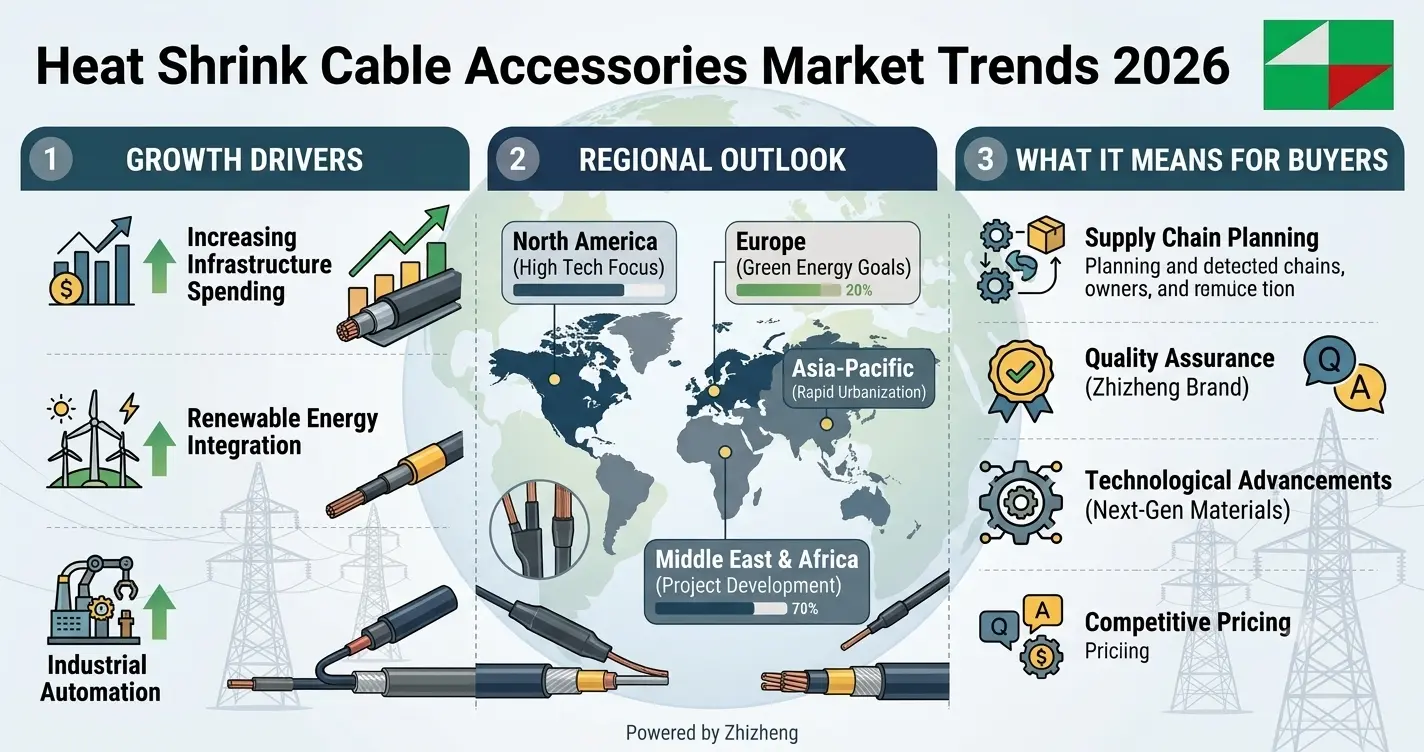
I want to be straightforward about something before we dive in: this article is not a sales pitch dressed up as market analysis. What I am going to do here is walk through the real numbers — where they come from, what is driving them, which regions matter most, and what the supply-side picture looks like for buyers and distributors trying to make sourcing decisions in 2026. I will also be honest about where Zhizheng fits in this picture, and where we do not.
If you are an industry analyst, a cable accessories distributor, or a procurement decision-maker at a utility or EPC contractor, this is the kind of context that should inform how you think about the next two to three years of heat shrink cable accessory demand.
The Headline Numbers: Market Size and CAGR in Context
Let's start with the figures that matter. The global heat shrink cable accessories market was valued at approximately USD 2,113.7 million in 2024, and is expected to grow to USD 2,263.7 million in 2025, reaching USD 4,500 million by 2035. The projected CAGR over the 2025–2035 forecast period is approximately 7.1%.
Now, a word of caution on market sizing figures in this industry: different research firms use different scope definitions, and that produces different absolute numbers. The 7.1% CAGR figure cited above applies specifically to the heat shrink cable accessories segment. For the broader heat shrink tubing category, Stratview Research estimates the market at USD 3.0 billion in 2025, growing at a CAGR of 5.8% during 2026–2031 to reach USD 4.2 billion. What is consistent across sources is the direction: sustained mid-to-high single-digit growth through the end of the decade.
To put that in perspective: a 7.1% CAGR means the market roughly doubles in value over ten years. For a category that many outside the electrical industry consider "mature infrastructure components," that is a meaningful growth trajectory. It reflects structural demand, not cyclical fluctuation.
The Broader Cable Accessories Industry: A Structural Growth Story
Heat shrink accessories do not exist in isolation — they are a segment within the larger cable accessories and power cable supply chain. Understanding the macro picture helps explain why the specific segment is growing.
The overall cable accessories market was valued at USD 35.8 billion in 2025 and is projected to grow from USD 37.93 billion in 2026 to USD 60.23 billion by 2034, at a CAGR of 5.95%. Meanwhile, the power cables market itself reached an approximate value of USD 157.31 billion in 2025 and is assessed to grow at a CAGR of 6.40% between 2026 and 2035.
The pattern is consistent: cables grow, and cable accessories grow with them — often at a slightly faster rate, because grid modernization, underground cabling programs, and renewable energy interconnections all disproportionately increase the number of joints, terminations, and protective components needed per kilometer of cable installed.
The cable accessories market demand is driven by increasing investments in power transmission and distribution infrastructure, rapid expansion of renewable energy projects, and growing deployment of underground and submarine cable networks. All three of these themes are accelerating in 2026, not slowing down.
Cable-Related Market Size Snapshot: 2025 Baseline
| Market Segment | 2025 Market Size | Forecast CAGR | Forecast Horizon | Source |
|---|---|---|---|---|
| Heat Shrink Cable Accessories | USD 2.26 B | 7.1% | 2025–2035 | WiseGuyReports |
| Heat Shrink Tubing (broad) | USD 3.0 B | 5.8% | 2026–2031 | Stratview Research |
| Cable Accessories (overall) | USD 35.8 B | 5.95% | 2026–2034 | Straits Research |
| Cable Accessories & Specialty Cable | USD 28.64 B | 7.2% | 2025–2035 | Emergen Research |
| Power Cables (parent market) | USD 157.31 B | 6.40% | 2026–2035 | Expert Market Research |
Note: Market sizing figures vary by research firm depending on scope definition and geographic coverage. All figures cited from published reports as of 2025–2026. Use as directional reference, not as a single authoritative figure.
Five Demand Drivers Shaping the Market in 2026
Every market forecast has a "growth drivers" section. Most of them list the same five things. But what matters is understanding which of those drivers are genuinely accelerating in 2026, and which are slower-moving structural trends. Here is my read, based on what I see on the ground and in project pipelines:
1. Grid Modernization and Underground Distribution Expansion
This is the single largest driver of cable accessory volume growth right now. Growing investments in grid modernization and underground power distribution are driving demand for advanced cable accessories that improve network reliability and operational safety, with utilities replacing aging transmission and distribution infrastructure with modern cable systems requiring high-performance joints, terminations, and connectors. In the United States specifically, the Grid Resilience and Innovation Partnerships (GRIP) Program supports large-scale grid upgrades, increasing deployment of underground cable infrastructure.
Underground cable programs are particularly significant for heat shrink accessories because each underground joint and termination requires a complete accessory system — stress relief, insulation, sealing, and outer protection — whereas overhead connections are simpler. More underground cable meters = disproportionately more accessory units per project.
2. Renewable Energy Infrastructure Buildout
The global cable accessories and specialty cable market, valued at USD 28.64 billion in 2025, is expected to reach USD 57.48 billion by 2035 at a CAGR of 7.2%, with demand increasing as utilities, renewable energy developers, and industrial operators expand power transmission and distribution infrastructure — including investments in offshore wind projects, data centers, and electrified transportation.
Germany is a clear example. Bundesnetzagentur reported in January 2026 that renewable installed capacity increased by nearly 21 GW in 2025 — each gigawatt of new generation capacity requires cable interconnections from generation site to substation to grid, and each of those connections requires properly specified accessories.
3. Rising Power Consumption in Developing Economies
Owing to population expansion and economic development, the average quantity of energy consumed per person is rising. Global power consumption reached over 25,400 terawatt-hours in 2022, and between 2021 and 2050, the typical global household's power consumption is expected to increase by more than 70%, driven primarily by developing countries' expanding economies.
This is not abstract. It translates directly into new substation construction, distribution line extensions, and industrial connection projects across South and Southeast Asia, Sub-Saharan Africa, and Latin America. These projects require cable accessories — and in many cases, they require accessories that can be installed by local crews under field conditions, which is where heat shrink technology's relative installation simplicity gives it a competitive advantage.
4. Electrification of Transportation
EV charging infrastructure, railway electrification, and port electrification all represent new end-use verticals for medium-voltage cable accessories that did not exist at scale a decade ago. These applications often involve below-grade or semi-exposed cable runs that require the same waterproofing and corrosion resistance as traditional power distribution accessories.
5. Material Innovation Expanding Application Range
Technological advancements, such as the development of new polymer materials and improved manufacturing processes, are enhancing the performance and durability of heat shrink cable accessories, making them more appealing to end-users. This is driving adoption in applications that previously used cold shrink or pre-molded technologies — not because those technologies are failing, but because improved heat shrink materials now meet specifications that previously required more expensive alternatives.
When I talk to distributors about why they are seeing stronger order volumes in 2025–2026 compared to 2022–2023, the answer is almost never one single driver. It's usually a combination: a national utility running an underground distribution upgrade, a neighboring industrial zone adding EV charging infrastructure, and a renewable energy park connecting to the same regional grid. The accessory demand from those three projects compounds in a way that is hard to predict from any single market report. The structural point is simply this: if electricity infrastructure is expanding in a region, cable accessory demand follows — reliably, and at scale.
Regional Breakdown: Where Growth Is Actually Happening
Global averages can be misleading. The 7.1% CAGR is a blended figure across very different regional growth profiles. Here is how the regional picture looks from where I sit:
Asia-Pacific: The Volume Engine
Asia Pacific dominated the cable accessories market with a market share of 38.67% in 2025. The Asia-Pacific heat shrink tubing market is expected to capture 35% share by 2035, driven by growing infrastructure development. China is the center of gravity here, but India, Indonesia, Vietnam, and the Philippines are all running significant grid expansion programs. Sales in China are forecast to expand at 7.5% CAGR from 2026 to 2036, backed by utility expansion and local heat shrink material availability.
For buyers sourcing from this region, the relevant point is that Chinese manufacturers — including ourselves at Zhizheng — have built production capacity on the back of this domestic demand surge, which creates export supply capacity that can be leveraged by international distributors and project contractors.
Europe: Quality-Led Replacement Cycle
European demand is less about volume growth from new infrastructure and more about the replacement and upgrading of aging cable systems to meet modern performance and environmental standards. Germany is expected to expand at a 5.1% CAGR between 2026 and 2036, reinforced by disciplined grid planning and renewable integration. Sales in the United Kingdom are estimated to post 5.8% CAGR by 2036, shaped by renewable cabling and contractor-led utility maintenance. European procurement teams tend to lead with certification requirements — UL, CE marking compatibility, REACH, RoHS — and these are non-negotiable for any supplier trying to access these markets.
Latin America: Utility-Led Growth with Renewable Catalyst
Brazil's renewable sources represented 50% of its energy matrix in 2024, reinforcing cable protection needs across renewable and grid maintenance programs. Demand in Brazil is projected at 6.0% CAGR through 2036, helped by energy system renewal and power distribution work. The rest of Latin America — particularly Chile, Colombia, and Mexico — is seeing similar dynamics, with both private renewable energy investment and public utility modernization programs creating cable accessory demand.
Middle East and Africa: New Build Dominance
This region is the most interesting from a longer-term supply perspective. Grid penetration rates in many Sub-Saharan African markets remain low, which means demand growth is not about replacement but about first-time installation. National electrification programs in Nigeria, Kenya, Ethiopia, and Tanzania are creating demand for the full spectrum of medium-voltage cable accessories, from 1kV distribution joints all the way to 35kV substation terminations. The price sensitivity in these markets is real, but so is the scale of the opportunity.
What This Means for Distributors and B2B Procurement Teams
Let me translate the market numbers into practical implications for the people who actually have to make sourcing decisions.
For Distributors
The growth trend is clear enough that stocking depth in heat shrink cable accessories — particularly medium-voltage termination and joint kits for 10kV and 35kV systems — should be considered a strategic inventory position, not a just-in-time purchase. Projects are getting larger, timelines are compressing, and contractors are increasingly penalized for delays caused by accessory supply shortfalls. Distributors who can guarantee stock availability on MV cable accessories have a real competitive differentiator.
The other implication is certification. Due to technological advancements, many organizations are enhancing their R&D capacity to develop new and better cable accessories with efficiency, safety, and reliability in terms of performance. Buyers are getting more sophisticated about what they demand from accessory suppliers. Distributors who cannot provide UL, SGS, or relevant IEC compliance documentation for the products they stock are increasingly locked out of utility and EPC procurement processes.
For B2B Procurement Teams
Supply chain concentration risk has become a real concern after 2020–2022. Evolving U.S. tariff policies introduce trade-cost volatility and supply-chain uncertainty in global cable accessory procurement. Procurement teams that over-rely on a single sourcing geography or a single supplier for MV cable accessories are exposed to disruption at exactly the wrong moment — when a grid project is on a critical path.
The practical response is to qualify two or three suppliers across different manufacturing locations for your key accessory categories, and to ensure that all qualified suppliers can meet your certification requirements. Price is important, but supply reliability across a multi-year project is often worth more than a 10% unit price saving.
When I evaluate a supplier for underground or industrial heat shrink cable accessories, I look at four things in this order: (1) Can they provide factory audit access or third-party quality system certification — ISO 9001 minimum? (2) Do they have product-specific test reports, not just general material certifications? (3) Can they demonstrate consistent batch-to-batch quality, not just a sample? (4) Have they actually supplied at scale to comparable projects — do they have references? A supplier who can answer yes to all four is worth paying attention to, regardless of their price point. A supplier who can answer yes to only one or two is a risk on a large project.
Zhizheng's Position in This Market: Supply Capacity and Product Scope
I will be direct about this rather than letting it be implicit. Zhizheng — Hubei Zhizheng Rubber & Plastic New Material Corp., Ltd. — is a mid-sized Chinese manufacturer with a specific focus on heat shrink and silicone rubber cable accessory products for power, automotive, and industrial applications. We are not one of the largest global players. What we are is a manufacturer with a clearly defined scope, significant production depth, and relevant certifications for international project work.
Production Infrastructure
Our facility in Huangshi Economic and Technological Development Zone covers 40,000 m² and integrates the full production process: raw material compounding, extrusion, irradiation cross-linking, heat expansion, and testing. We also operate a production base in Dongguan, established in 2005, which provides additional capacity and proximity to southern China export logistics.
The reason this matters for buyers is batch consistency. The global heat shrink cable accessories market is projected to witness significant growth driven by increasing demand for reliable and efficient electrical insulation solutions. "Reliable" in practice means the product you receive in month eighteen of a project is dimensionally and mechanically identical to what you received in month one. Vertical integration of the manufacturing process is what makes that possible — you cannot guarantee cross-linking consistency if you are sourcing pre-irradiated tubing from a third party.
Voltage Range and Product Coverage
Our heat shrink cable accessory range covers the 1kV, 10kV, and 35kV voltage classes — the three standard distribution voltage levels across most of the markets where we see strongest demand growth in 2026. Specifically:
Heat Shrink Termination Kits: RSY-1 (1kV), RSY-10 (10kV), RSY-35 (35kV) — for cable ends in switchgear, substations, and above/below-grade outdoor installations.
Heat Shrink Cable Joint Kits: JRSY-10 (10kV), JRSY-35 (35kV) — for straight-through joints in underground and conduit distribution runs.
Component Tubing: HDW Dual Wall Semiconductive Tubing, Anti-Tracking Insulation Tubing, Medium Wall Heat Shrink Tubing, Heat Shrink Cable Breakout Boots, DSQ Heat Shrink Cable Sheds — for OEM integrators and contractors building custom accessory kits.
Busbar Protection: MPG-01 (1kV), MPG-10 (10kV), MPG-35 (35kV) heat shrink busbar insulation tubing for switchgear and panel board applications.
Automotive Grade: LRS-1 Thin Wall, SRS-3X/4X Dual Wall, YRS Oil-Resistant tubing under IATF 16949 certification — for wiring harness OEMs and tier-1 automotive suppliers.
Certifications Relevant to Global Project Work
Our production quality system is certified under ISO 9001:2015. We hold ISO 14001:2015 environmental management certification and IATF 16949 for automotive applications. Product-level certifications include UL recognition and SGS REACH and RoHS compliance certificates. We also hold a Type Test Report for 35kV cold shrink cable accessories and the National High-Tech Enterprise certificate — the latter reflecting continued R&D investment in polymer materials development.
For procurement teams qualifying suppliers for utility or EPC projects, these documentation packages are available for review.
Looking for a specific product datasheet or want to explore custom accessory requirements? Browse the Zhizheng Heat Shrink Cable Accessories Product Range →
Risks and Constraints Worth Watching
No honest market outlook leaves out the downside scenarios. Here are the risks that I think warrant attention from buyers, distributors, and analysts in 2026:
Trade Policy Volatility
Evolving U.S. tariff policies introduce trade-cost volatility and supply-chain uncertainty across the cable accessory category broadly. Buyers in North America sourcing from Chinese manufacturers face an uncertain tariff environment that can shift landed costs significantly within a project cycle. This does not necessarily mean sourcing from China is wrong — but it does mean procurement teams should model tariff scenarios into total cost of ownership calculations and maintain flexibility in their supplier qualification processes.
Raw Material Price Exposure
Heat shrink cable accessories use polymer materials — primarily cross-linked polyolefins and silicone rubber — that are derived from petrochemical feedstocks. Oil price volatility flows through to raw material costs with a lag, and that affects manufacturer margins and, eventually, product pricing. Buyers on long-term supply agreements should understand how their supplier contracts handle raw material price escalation.
Qualification Cycle Length
In utility procurement, supplier qualification — including type testing, factory audit, and reference project verification — can take twelve to eighteen months. That means buyers who are not already in the qualification process for new suppliers are already behind for projects starting in late 2027 or 2028. The market growth numbers only translate into business opportunity if the supply relationships are in place before the project demand materializes.
Installation Quality as a Limiting Factor
The global wire and cable industry entered 2026 with solid fundamentals, supported by irreversible trends such as energy transition, electrification, and digital infrastructure expansion, with opportunities concentrated in high-end, policy-supported segments and fast-growing emerging markets — where strategic positioning, technological capability, and global market access will define competitive success. But all of that assumes the accessories are correctly installed. In high-growth emerging markets where skilled electrical labor is scarce, poor installation quality can turn a technically sound product into a premature field failure. Suppliers who invest in field installation training and documentation — not just product quality — are better long-term partners for projects in these markets.
Frequently Asked Questions
Contact: hszzjohnlee@aliyun.com | www.hubeizhizheng.com
WiseGuyReports. Heat Shrink Cable Accessories Market Size, Share, Industry Trends, Forecast 2035. August 2025. Market value: USD 2,263.7M (2025); CAGR 7.1% (2025–2035).
Stratview Research. Heat-Shrink Tubing Market Size, Share & Growth Analysis. March 2026. Market value: USD 3.0B (2025); CAGR 5.8% (2026–2031).
Straits Research. Cable Accessories Market Size, Share, Growth, 2034. 2026. Market value: USD 35.8B (2025); CAGR 5.95% (2026–2034).
Emergen Research / OpenPR. Cable Accessories & Specialty Cable Market to Expand at 7.2% CAGR. July 14, 2026. Market value: USD 28.64B (2025).
Expert Market Research. Power Cables Market Size, Share & Industry Trend Report. 2026. Market value: USD 157.31B (2025); CAGR 6.40% (2026–2035).
Future Market Insights. Heat Shrink Kits Market: Global Industry Analysis and Opportunity Assessment, 2036. 2026. China CAGR 7.5% (2026–2036); Brazil CAGR 6.0%.
QY Research. Global Heat Shrink Cable Joints Market Outlook, Forecast to 2032. June 2026. Segment value: USD 1,258M (2025).
Bundesnetzagentur (Federal Network Agency, Germany). Renewable installed capacity announcement, January 8, 2026. Cited via Future Market Insights.
NPC Electric. Global Wire and Cable Industry Review 2025 and Market Outlook 2026. February 2026.
Hubei Zhizheng Rubber & Plastic New Material Corp., Ltd. — Company profile, product documentation, and certification records, 2025–2026. www.hubeizhizheng.com
IEC 60502-4:2010 — Power cables with extruded insulation and accessories, rated voltages 6 kV to 30 kV — Test requirements on accessories.