



How to Choose a Cable Accessories Supplier from China: A Practical Checklist for Importers & Distributors (2026)
2026-07-26 11:22
How to Choose a Cable Accessories Supplier from China: A Practical Checklist for Importers, Distributors, and OEM Buyers
I want to start by acknowledging something that most Chinese manufacturers would never say in a piece of content like this: the concerns overseas buyers have about sourcing cable accessories from China are often legitimate. I have been in this industry for over twenty years, and I have seen what happens when a buyer selects a supplier based on the lowest unit price, receives a first shipment that looks acceptable, and then discovers six months later — when the accessories are already installed in the field — that batch consistency was never there. The cost of that outcome, in warranty claims, project delays, and damaged customer relationships, is an order of magnitude larger than whatever was saved on the original purchase.
So this article is not going to tell you that buying from China is risk-free or that every Chinese manufacturer is equally reliable. What it is going to do is give you a structured checklist — the same checklist I would use if I were on the buying side of this decision — for evaluating any heat shrink cable accessories manufacturer in China, including Zhizheng. Work through these criteria systematically, and you will have what you need to make a defensible sourcing decision.
This is written for distributors, importers, and OEM customers in Europe, North America, the Middle East, and Africa who are either qualifying a new supplier or re-evaluating their existing supply chain.
Why Supplier Selection Matters More Than Unit Price
Cable accessories are not a commodity in the same way that copper cable is a commodity. A meter of copper cable from one manufacturer is essentially the same product as a meter of copper cable from another manufacturer at the same specification — the raw material dominates. A heat shrink cable joint kit is different. The performance of that joint twenty years from now depends on the polymer formulation, the consistency of the irradiation cross-linking process, the adhesive bonding layer quality, and the dimensional accuracy of each component. All of those variables are controlled by the manufacturer's process — not the raw material price.
What this means practically: a heat shrink cable accessory supplier with a 15% lower unit price but inconsistent process control is not cheaper than a slightly higher-priced supplier with a stable manufacturing system. The risk-adjusted cost of the cheaper option — when you factor in the probability and consequence of field failures, warranty claims, and customer relationship damage — is almost always higher.
This is the lens through which everything in this checklist should be read. You are not evaluating price. You are evaluating risk-adjusted total cost of supply, over the full service life of the products you are distributing or installing.
Over twenty years, I have watched the same cycle repeat: a buyer switches to a cheaper supplier, the first two shipments are fine, the third shipment has a dimensional variance that is just within tolerance, and by the sixth shipment something has quietly drifted outside specification. The buyer doesn't know until a contractor reports installation problems in the field. The damage to that distributor's reputation with their end customer cannot be priced. The right question when evaluating a Chinese supplier is not "is this the cheapest?" It is "what systems does this manufacturer have in place to ensure that shipment number fifty looks identical to shipment number one?"
The Six-Category Evaluation Framework
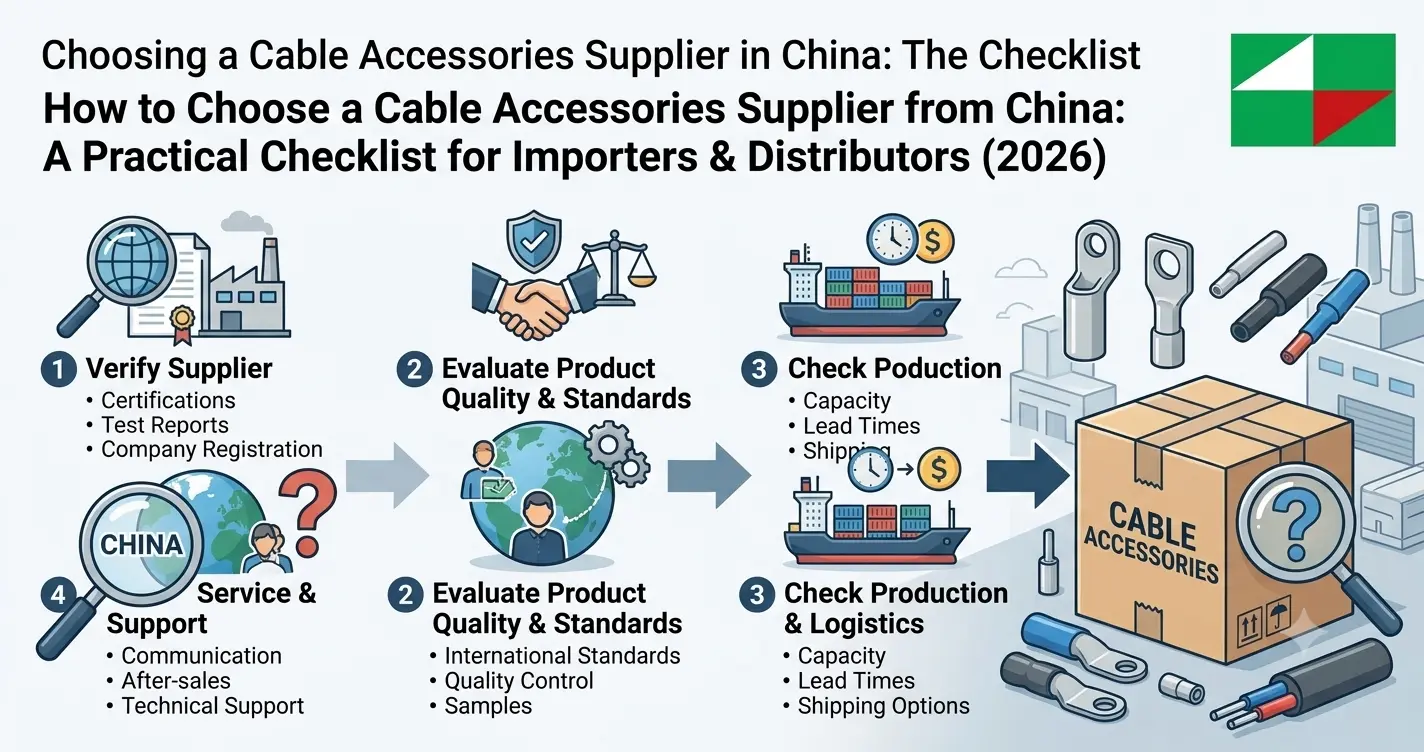
I recommend evaluating any China-based heat shrink cable accessories manufacturer across six categories. These are not ranked in order of importance — all six matter — but I will explain why each one is relevant and what specific evidence you should ask for in each case.
Category 1: Manufacturing infrastructure and vertical integration
Category 2: Quality system certification and documented evidence
Category 3: Product-level compliance — UL, SGS, and international standards
Category 4: Export track record and reference projects
Category 5: Lead time reliability and supply continuity
Category 6: Technical support and post-sale responsiveness
For each category I will give you the key questions to ask and the specific documents or evidence that constitutes an adequate answer.
Category 1 — Manufacturing Infrastructure and Vertical Integration
The first thing I want to understand about any heat shrink cable accessory manufacturer is the physical scope of their production. Specifically: how much of the production process do they actually control internally, versus subcontract or source from third parties?
This matters because the most critical quality variables in heat shrink cable accessory manufacturing — polymer compounding, extrusion geometry, irradiation cross-linking dose, expansion ratio, adhesive layer thickness — are process-controlled, not material-controlled. If a manufacturer is buying pre-extruded tubing from one supplier and irradiation services from another, they have limited ability to guarantee consistency across the full production chain. When something goes wrong in batch number thirty, they often cannot even trace the root cause.
A vertically integrated manufacturer controls the complete process from compounding through to finished and tested product. That is the foundation on which consistent quality is built.
Questions to Ask in Category 1
What is the footprint of your manufacturing facility, and does it encompass the full production chain?
Do you compound your own polymer formulations, or do you purchase pre-compounded materials?
Is irradiation cross-linking performed in-house or subcontracted?
What testing equipment do you have on-site, and what parameters are routinely tested on each production batch?
Can you provide a factory visit or third-party audit access prior to order placement?
What Constitutes an Adequate Answer
A credible manufacturer should be able to provide: a facility size figure that correlates with claimed production capacity; a clear description of which processes are in-house versus outsourced; a list of in-house testing capabilities including specific equipment (tensile testers, high-voltage test sets, dimensional gauges); and a willingness to host a factory audit, either by the buyer directly or by a recognized third-party inspection firm.
Manufacturers who deflect factory visit requests, or who cannot clearly describe their in-house production scope, are a flag.
Category 2 — Quality System Certification and Documented Evidence
ISO 9001 certification is the baseline requirement. This is not because ISO 9001 guarantees product quality — it does not. What it does guarantee is that the manufacturer has a documented quality management system that has been audited by an accredited third party, and that the system covers defined procedures for production control, incoming material inspection, in-process testing, non-conformance handling, and corrective action.
The certificate tells you that the system existed and passed audit at the time of certification. Ongoing compliance is what matters, which is why you should check the certificate's validity date and confirm that annual surveillance audits have been completed.
Questions to Ask in Category 2
Are you currently certified under ISO 9001:2015? Can you provide the certificate and confirm the certifying body?
When was your most recent surveillance audit, and what was the outcome?
Do you hold any additional management system certifications — ISO 14001, OHSAS 18001, or IATF 16949?
Can you provide a sample inspection report or batch quality certificate for a recent production run?
What is your process for handling a non-conforming shipment after delivery?
What Constitutes an Adequate Answer
A current, valid ISO 9001:2015 certificate from a recognized accreditation body (e.g., Bureau Veritas, SGS, TÜV, Intertek). A willingness to share batch quality certificates — not just a marketing brochure describing their quality system. A clear and specific answer to the non-conformance handling question, including who is the contact point and what the resolution process looks like. Manufacturers who respond to quality system questions with generic statements about "strict quality control" but cannot produce specific documentation are not ready for serious international business.
Quality & Compliance Certification Reference Table
| Certification | What It Covers | Required For | Zhizheng Holds? |
|---|---|---|---|
| ISO 9001:2015 | Quality management system — production process control and consistency | All markets — baseline requirement | ✅ Yes |
| ISO 14001:2015 | Environmental management system | European markets, ESG-conscious procurement | ✅ Yes |
| IATF 16949 | Automotive quality management — wiring harness applications | Automotive OEM supply chains | ✅ Yes (since 2019) |
| UL Recognition | Product-level safety testing against UL standards | North America, global projects with UL specification | ✅ Yes |
| SGS REACH Compliance | Chemical substance compliance — EU regulation | European Union markets — mandatory for import | ✅ Yes |
| SGS RoHS Compliance | Restriction of hazardous substances in electrical equipment | EU, UK, and many Asian markets | ✅ Yes |
| IEC 60502-4 Type Test | Performance testing of accessories for MV cables (6–30 kV) | Utility and EPC procurement specifications | ✅ Yes (35kV) |
| National High-Tech Enterprise | Chinese government designation — R&D investment and technical capability | Indicator of ongoing technology development commitment | ✅ Yes |
Category 3 — Product-Level Compliance: UL, SGS, and International Standards
This category is distinct from quality system certification, and the distinction matters. ISO 9001 tells you that the factory has controlled processes. UL recognition, SGS compliance testing, and IEC type test reports tell you that specific products have been independently tested against defined performance standards. You need both.
A factory can have perfect ISO 9001 documentation and still produce cable accessories that do not meet the electrical or mechanical performance requirements of your target market. Product-level compliance testing is the only way to verify that the actual product performs to specification.
What to Verify in Category 3
UL recognition or listing: For North American markets and for many international project specifications that reference UL standards, UL recognition on the specific product category is required. Ask for the UL file number and verify it directly at ul.com/database. Certificate copies are not sufficient — live database verification is the only reliable confirmation.
SGS REACH and RoHS reports: For European import, REACH and RoHS compliance are legally mandatory, not optional. These reports need to be current (REACH candidate list is updated regularly) and product-specific — a general company-level REACH statement is not the same as a product-tested compliance certificate.
IEC type test reports: For medium-voltage cable accessories, IEC 60502-4 (for 6 kV to 30 kV accessories) and related standards govern type testing of electrical performance including partial discharge, high-voltage withstand, tan delta, and thermal cycling. A manufacturer claiming MV cable accessory capability without type test documentation for the relevant voltage class is not a credible supplier for utility projects.
Market-specific approvals: Some markets have additional requirements. Gulf Cooperation Council (GCC) countries require SASO or ESMA certification for electrical products. South Africa may require SABS approval for certain utility applications. Confirm that your target market's specific approval requirements are covered before placing an order.
I have seen manufacturers present UL certificates that are real — but for a different product category than the one being purchased, or that have lapsed and not been renewed. The only way to be certain is to take the UL file number provided by the manufacturer and search it directly at UL's public database at ul.com/database. Check that the listed products match what you are buying, and that the file status is "active." This takes five minutes and can save you significant compliance exposure. Do not accept a scanned certificate without doing this verification step.
Category 4 — Export Track Record and Reference Projects
A manufacturer who has been producing for domestic China market only is a fundamentally different supply risk than one who has been exporting the same product categories to demanding international markets for ten or twenty years. The reasons are practical, not cultural.
Exporting to markets in Europe, North America, and the Middle East forces manufacturers to maintain compliance with regulatory frameworks that are more rigorous than Chinese domestic requirements in several areas — particularly chemical substance compliance, electrical safety certification, and documentation standards. Manufacturers who have been navigating these requirements across multiple markets for a long time have built institutional knowledge and process infrastructure that domestic-only suppliers simply do not have.
Reference projects and customer references serve a different purpose: they tell you whether this manufacturer's products have actually performed in the field in conditions similar to yours. A heat shrink 35kV cable joint kit that has a type test report and has been installed in a working distribution network in Germany for five years without failures is a different level of evidence than one that has a type test report and has only been sold domestically.
Questions to Ask in Category 4
How many countries do you currently export to, and which are your largest markets by volume?
How long have you been exporting to my target region?
Can you provide two or three customer references — distributors or project contractors — who I can contact directly?
Can you share project references where your MV cable accessories have been installed and are in active service?
Have you supplied products into utility-scale projects (not just commercial or residential applications)?
Category 5 — Lead Time Reliability and Supply Continuity
This is an area where Chinese manufacturers generally have an advantage — large integrated facilities can respond to volume surges faster than smaller regional manufacturers — but it is also an area where the gap between manufacturers is significant. The question is not just "what is your quoted lead time?" It is "what is your track record of hitting quoted lead times under various demand conditions?"
What to Evaluate in Category 5
Production capacity headroom: Ask about current utilization rate. A manufacturer running at 95% of capacity has almost no ability to absorb a surge order without pushing out delivery for other customers. A manufacturer at 70% capacity has buffer.
Raw material stocking policy: Lead time for heat shrink accessories is not just production time — it includes raw material availability. Ask whether the manufacturer maintains safety stock on key polymer inputs, or whether each order triggers a raw material purchase that adds lead time.
Logistics and export experience: Exporting from China involves customs documentation, export licensing for some product categories, and logistics coordination. A manufacturer with long export experience has streamlined processes here. A manufacturer new to export may have efficient production but slow or error-prone logistics.
Communication and order tracking: During a project with a critical path, you need to know the status of your shipment in real time, not just when there is a problem. Ask how order status is communicated and what the escalation process is if a delay is anticipated.
One practical test I recommend: ask the manufacturer for their on-time delivery rate for the past twelve months, and ask whether this is tracked formally. Manufacturers with mature export operations track this metric routinely. Those who cannot provide a figure — even an approximate one — likely do not have the supply chain discipline that demanding international projects require.
Category 6 — Technical Support and Post-Sale Responsiveness
For heat shrink cable accessories specifically, technical support is not a luxury — it is a functional requirement. The reason is installation complexity. A 35kV cable joint kit has multiple components, and the installation sequence matters. Getting the stress control tube placement wrong, or under-shrinking the outer sealing tube, can produce a joint that tests fine immediately after installation but fails under thermal cycling load within a year. Field crews need access to clear installation documentation, and ideally to a technical contact who can answer specific questions about their cable type and installation conditions.
For OEM customers who are integrating heat shrink components into their own product designs, technical support requirements go further: you need a supplier who can work with your engineering team to adapt formulations or dimensions, provide application testing support, and iterate on product specifications without requiring a full new product development cycle each time.
Questions to Ask in Category 6
Do you provide installation instructions in English (or the language of our target market)?
Is there a dedicated technical contact — not just a sales person — who can respond to installation questions from our customers or contractors?
What is your typical response time to a technical inquiry?
If a product performance issue arises after delivery and installation, what is your resolution process?
For OEM customers: can you support customization of dimensions, materials, or shrink ratios? What is the minimum order quantity and lead time for a custom specification?
How Zhizheng Performs Against These Six Categories
I said at the start of this article that this checklist applies to any Chinese manufacturer, including Zhizheng. Here is how we stand against each of the six categories, stated as directly as I can manage.
Category 1 — Manufacturing Infrastructure
Our production facility in Huangshi Economic and Technological Development Zone covers 40,000 m² and integrates the complete production process: polymer compounding, extrusion, electron beam irradiation cross-linking, heat expansion, and finished product testing. We also operate a production base in Dongguan, established in 2005. Irradiation cross-linking is performed in-house — this is the most critical quality-determining step in heat shrink production, and keeping it in-house is a deliberate choice to maintain process control. We do not subcontract irradiation. Our in-house testing capability covers dimensional verification, tensile and elongation testing, high-voltage withstand, and visual inspection protocols. Factory visit access is available to qualified buyers; we can also facilitate third-party audit arrangements.
Category 2 — Quality System Certification
We hold ISO 9001:2015 quality management system certification, ISO 14001:2015 environmental management system certification, and IATF 16949 automotive quality management certification (obtained in 2019). All certificates are current and subject to annual surveillance audits. We can provide copies of all certificates and batch quality documentation upon request. Our process for handling non-conforming product is documented under our QMS and includes dedicated contact escalation for international customer claims.
Category 3 — Product-Level Compliance
Our products hold UL recognition. We hold SGS-issued REACH compliance certificates (updated for 2025 REACH candidate list) and RoHS compliance certificates for our heat shrink product lines. For MV cable accessories, we hold a Type Test Report for our 35kV cold shrink cable accessories conducted in accordance with relevant IEC standards. We are also a designated National High-Tech Enterprise in China, which reflects ongoing R&D investment in polymer materials and production process development. Full documentation packages are available for buyer review — not on request after you place an order, but as part of the qualification process before you commit.
Category 4 — Export Track Record
We have been exporting heat shrink cable accessories since the early 2000s and currently supply customers in more than 30 countries across Europe, the Middle East, Africa, Southeast Asia, and Latin America. Our products are in active service in power distribution, automotive wiring harness, and railway applications across multiple markets simultaneously. We can provide distributor references in several regions. What I will not do is give you a list of specific project names without the customer's permission — but I will facilitate direct introductions to existing customers who are willing to be references for qualified buyers.
Category 5 — Lead Time and Supply Continuity
Standard product lead times from our 40,000 m² facility are 15–25 working days for most catalog items, depending on order volume and current production scheduling. We maintain raw material inventory buffers on our highest-volume polymer inputs to reduce exposure to raw material supply disruption. Our logistics team handles export documentation, customs coordination, and freight arrangements for international shipments routinely. For large project orders with defined delivery schedules, we can discuss reserved production capacity arrangements. We track on-time delivery performance formally and can provide recent data on request.
Category 6 — Technical Support
All of our product installation documentation is available in English, with additional language versions available for key markets upon request. We have a dedicated technical support function separate from the sales team — questions about installation procedure, cable type compatibility, or product selection for a specific application route to engineering, not to account management. For OEM customers requiring custom dimensions, shrink ratios, or material formulations, we have an active custom development process. Minimum order quantities for custom specifications are project-dependent and discussed during the requirements phase.
Ready to review our product range and request documentation? Explore Zhizheng Heat Shrink Cable Accessories — 1kV to 35kV →
Red Flags: What to Watch Out For
Based on what I have seen in this industry over twenty years, here are the patterns that should immediately raise your level of scrutiny when evaluating a Chinese heat shrink cable accessories supplier:
Certificates available but database verification fails: As noted earlier — any UL, SGS, or ISO certificate should be independently verifiable. If verification fails or the scope of certification does not match the products being sold, walk away.
Lead times that are unrealistically short: A manufacturer quoting 5-day lead times on 35kV cable joint kits either has excessive inventory of product they could not sell elsewhere, or is not being honest about their production timeline. Either scenario is a problem.
No product-level type test documentation for MV accessories: Type testing for 35kV cable accessories requires specialized high-voltage test facilities and produces a substantial technical report. Manufacturers who cannot produce this documentation for their MV products simply have not done the testing — which means you are taking the risk that their product actually meets specification.
Inability to facilitate a factory visit or third-party audit: Credible manufacturers welcome audits. Manufacturers who deflect or delay audit requests have something to hide, or do not have the infrastructure they claim.
Technical support routed entirely through sales: When you ask a technical question and the response is "I will ask our team and get back to you" — and the response you receive looks like a sales brochure rather than a technical answer — the manufacturer does not have the technical depth to support your customers in the field.
No export history in your target region: A manufacturer who has never exported to your market does not know your regulatory requirements, your logistics environment, or your customer expectations. The first export to a new region is always learning — you do not want to be the one paying for that learning curve.
Pricing that is significantly below market: The material costs and process costs for legitimate heat shrink cable accessories — particularly for MV voltage class products with proper cross-linking and certified materials — are not compressible beyond a certain floor. If pricing is significantly below what other credible manufacturers are quoting for equivalent specification, something in the quality chain has been compromised. The question is which part.
The OEM-Specific Evaluation Layer
If you are an OEM customer — integrating heat shrink tubing or components into your own branded cable accessory kits, wiring harness assemblies, or switchgear products — the six-category framework above applies, but there are additional factors specific to your situation.
Custom Development Capability
Your requirement is probably not an off-the-shelf catalog item. You need a manufacturer who can work from your engineering drawings or performance specifications, produce development samples, iterate through testing, and reach a stable production specification within a commercially reasonable timeline. This requires actual materials and process engineering capability — not just an ability to adjust mold dimensions. Ask to speak with the engineering team responsible for new product development, not just the product manager or sales contact.
Minimum Order Quantity Flexibility
OEM supply relationships often start with small validation quantities and scale up as the OEM product ramps. A supplier whose MOQ for custom specifications starts at full container loads is not appropriate for the validation phase. Understand the supplier's MOQ structure across the development lifecycle and what pricing adjustments apply at different volume tiers.
IP Protection and Exclusivity
If you are sharing proprietary design information — specific formulations, dimensional drawings, performance test data — with a Chinese manufacturer for OEM product development, understand what contractual protections are in place. Non-disclosure agreements should be standard. Exclusivity arrangements for your specific product specifications, if commercially justified, should be explicitly agreed and documented.
Packaging and Labeling
OEM customers typically require products delivered under their own brand and packaging. Confirm that the manufacturer has experience with OEM packaging production, including bilingual labeling requirements and market-specific compliance marking (CE marking for Europe, for example). A manufacturer who only ships in their own branded packaging is adding a step to your receiving and re-packaging process that affects your cost and lead time.
Frequently Asked Questions
Contact: hszzjohnlee@aliyun.com | Tel: +86 187 72277521 | www.hubeizhizheng.com
ISO 9001:2015 — Quality Management Systems: Requirements. International Organization for Standardization. iso.org
ISO 14001:2015 — Environmental Management Systems: Requirements with Guidance for Use. International Organization for Standardization.
IATF 16949:2016 — Quality Management System Requirements for Automotive Production and Relevant Service Part Organizations. International Automotive Task Force.
UL Certification Database. UL Solutions. Publicly searchable at ul.com/database
IEC 60502-4:2010 — Power cables with extruded insulation and their accessories, rated voltages 6 kV to 30 kV — Part 4: Test requirements on accessories for cables with rated voltages from 6 kV to 30 kV. International Electrotechnical Commission.
Regulation (EC) No 1907/2006 (REACH) — Registration, Evaluation, Authorisation and Restriction of Chemicals. European Chemicals Agency (ECHA). echa.europa.eu
Directive 2011/65/EU (RoHS 2) — Restriction of the Use of Certain Hazardous Substances in Electrical and Electronic Equipment. European Parliament and Council.
Hubei Zhizheng Rubber & Plastic New Material Corp., Ltd. — Company profile, certification documentation, and product technical records, 2025–2026. www.hubeizhizheng.com
IEC 60229:2007 — Tests on Cable Oversheaths Which Have a Special Protective Function. International Electrotechnical Commission.