


Heat Shrink vs Cold Shrink Cable Accessories: An Honest Comparison 2026
2026-03-30 23:01
Senior Technical Engineer · Hubei Zhizheng Rubber & Plastic New Material Corp., Ltd.
Published: 2026 · Reading time: 20 min
I manufacture both heat shrink and cold shrink cable accessories — have done for over fifteen years. So when a customer calls and says, "Which one should I use?", I don't have a financial incentive to push one over the other. Both come off our production lines in Huangshi. Both carry our name. Both keep the lights on for my company.
But they are fundamentally different technologies. And the wrong choice doesn't just waste money — it can shorten the life of your cable system, create safety risks for your jointers, or put your project timeline in jeopardy.
This cable accessory technology comparison is based on real production data from our factory, failure analysis reports I've reviewed over the years, and installation feedback from contractors across North America, Europe, the Middle East, and Southeast Asia. I'll cover every factor that actually matters: working principle, performance, installation requirements, cost structure, voltage range, environmental suitability, and long-term reliability. And at the end, I'll give you a decision framework you can apply to your specific project.
No marketing fluff. Just what I'd tell you face-to-face.
? Table of Contents
1. The Fundamentals: Two Technologies, One Goal
Before we compare, let me be clear about what both technologies share: the same objective. Whether heat shrink or cold shrink, a cable accessory exists to reconstruct the electrical insulation system at the points where the factory-made cable has been cut open — terminations and joints. Both must restore stress control, insulation integrity, environmental sealing, and mechanical protection. The cable doesn't care which technology you use. It only cares whether the interface is void-free, electrically sound, and sealed against moisture.
The difference lies in how that seal is created — and that "how" drives all the downstream implications for installation, performance, cost, and project logistics.
Heat Shrink Cable Accessories — The Established Standard
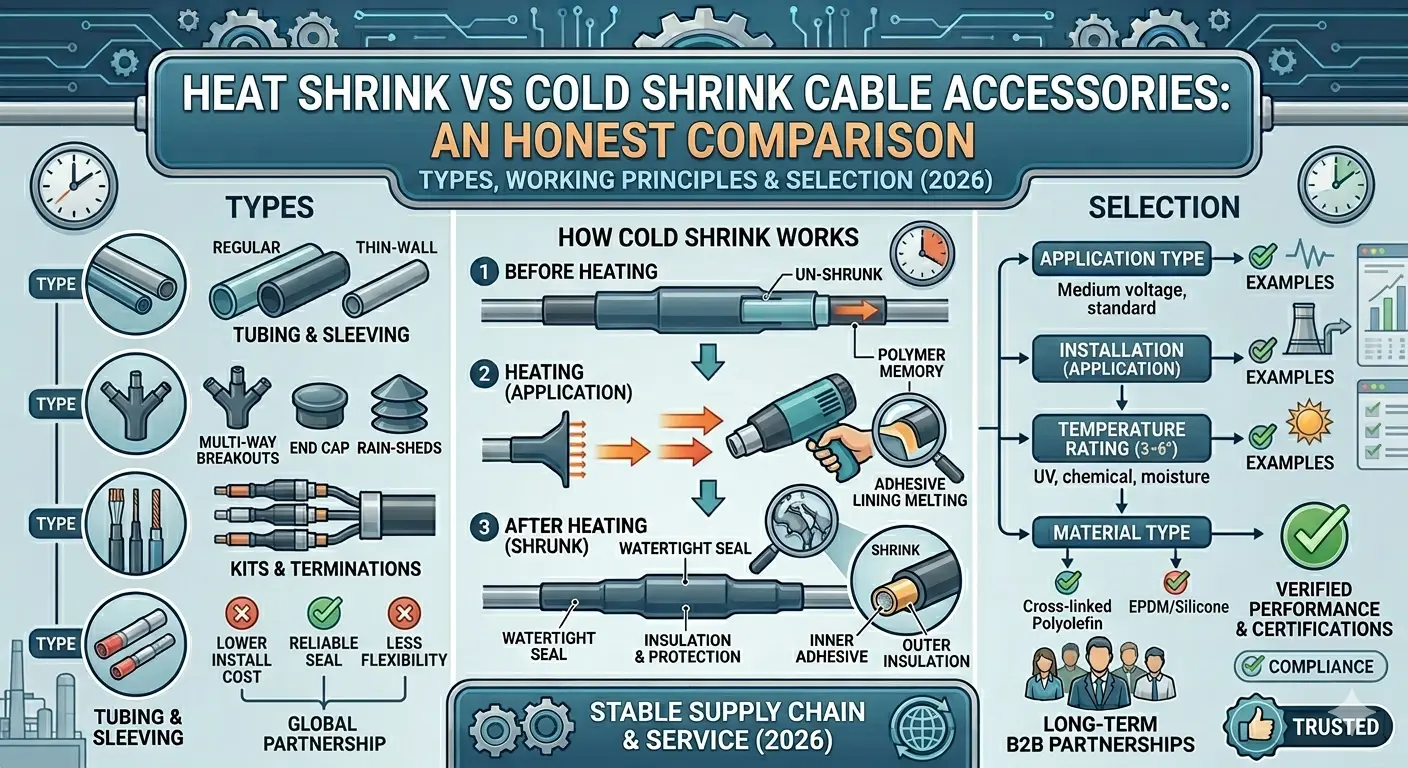
Heat shrink technology has been the backbone of cable accessory installations worldwide since the 1960s. The base material is cross-linked polyolefin — a thermoplastic polymer that has been irradiated (typically by electron beam) to create cross-linked molecular bonds. These cross-links give the material "shape memory." In the factory, the material is heated and mechanically expanded. On site, when a jointer applies heat (90–130°C), it recovers toward its original smaller diameter, creating a tight, conformable seal around the cable substrate.
It's a proven, well-understood, and globally standardized approach — with over six decades of cumulative field data behind it.
Cold Shrink Cable Accessories — The Newer Alternative
Cold shrink technology emerged as a commercial alternative in the late 1980s and early 1990s. The base material is silicone rubber (or EPDM rubber in some older designs) — an elastomer that is pre-stretched over a removable support core (typically a spiral plastic tube or a collapsible inner cage). On site, the installer removes the support core, and the rubber contracts under its own stored elastic energy to grip the cable. No heat, no flame, no special tools.
It's an elegant concept — and in the right applications, it delivers real advantages. But it is not universally superior. Let me explain why.
2. How Each Technology Works — Factory to Field
Understanding the manufacturing process helps you understand the performance characteristics. I've walked thousands of visitors through our production lines in Huangshi, and this factory-level context always changes how engineers evaluate the two technologies.
2.1 Heat Shrink: Extrusion → Irradiation → Expansion
Step 1 — Compounding & Extrusion: We formulate specific polyolefin compounds for each functional layer — stress control (high-permittivity ZnO or SiC-loaded), insulation (high-dielectric-strength), semiconductive (carbon-loaded), and anti-tracking (ATH-filled). Each compound is extruded into tubes with precise wall thickness and diameter tolerances.
Step 2 — Electron-Beam Irradiation: The extruded tubes pass through our irradiation line, where controlled electron-beam exposure creates cross-links between polymer chains. This is the critical step that gives the material its shape memory. The irradiation dose must be precisely controlled — too little and the material won't recover fully; too much and it becomes brittle.
Step 3 — Expansion: The irradiated tubes are reheated above their crystalline melting point and mechanically expanded to a larger diameter (typically 2:1 or 3:1 ratio). When cooled, they retain the expanded shape — but the cross-linked molecular memory "remembers" the original smaller diameter.
Step 4 — Kit Assembly: The individual components (stress control tube, insulation tube, anti-tracking outer tube, breakout boots, mastic seals, mechanical hardware) are assembled into complete kits for specific cable types and voltage classes.
On Site: The jointer slides the expanded tubes over the prepared cable, applies heat with an industrial heat gun or propane torch, and the tubes shrink uniformly to create intimate, void-free contact with the cable substrate.
2.2 Cold Shrink: Molding → Pre-Stretching → Core Loading
Step 1 — Silicone Rubber Molding: We mold silicone rubber components — typically in a single integrated body that combines stress control, insulation, and shielding functions. The rubber is cured (vulcanized) to create a stable elastomer with permanent elastic recovery properties.
Step 2 — Pre-Stretching & Core Loading: The cured rubber body is stretched and loaded onto a removable support core. This core holds the rubber in its expanded state during storage, shipping, and the initial stages of installation.
On Site: The installer positions the pre-stretched rubber body over the prepared cable junction, then removes the support core (by unwinding a spiral tube or collapsing a cage mechanism). The rubber contracts under its own elastic force to grip the cable.
3. Side-by-Side Comparison: 12 Factors That Actually Matter
This is the table my sales team uses internally when advising customers. It's based on our production specs and field feedback — not generic textbook data.
| Comparison Factor | Heat Shrink | Cold Shrink | Edge |
|---|---|---|---|
| Base Material | Cross-linked polyolefin (PE/EVA) | Silicone rubber (or EPDM) | — |
| Installation Method | Heat gun / propane torch (90–130°C) | Pull-to-remove support core (no heat) | Cold Shrink |
| Installation Speed | Moderate — heating time per component adds up | Faster — no heating/cooling cycles needed | Cold Shrink |
| Installer Skill Level | Higher — even heat technique is critical | Lower — more forgiving of technique variation | Cold Shrink |
| Mechanical Strength | High — rigid after recovery; excellent abrasion resistance | Moderate — elastic; softer surface more susceptible to damage | Heat Shrink |
| Voltage Range Coverage | 1 kV – 35 kV (full commercial range readily available) | 1 kV – 35 kV (but 35 kV options fewer; LV range limited) | Heat Shrink |
| Material Unit Cost | Lower — polyolefin is significantly cheaper than silicone | Higher — medical/industrial-grade silicone rubber is premium | Heat Shrink |
| Thermal Cycling Response | Rigid — doesn't expand/contract with the cable | Elastic — continuously conforms to dimensional changes | Cold Shrink |
| Chemical Resistance | Good — resistant to oils, fuels, common industrial chemicals | Good — silicone excels at UV & ozone; weaker to hydrocarbons | Depends |
| Shelf Life | 5–10 years (no degradation in storage) | 2–3 years (elastic force decays over time on core) | Heat Shrink |
| Hazardous/Confined Spaces | Not suitable — requires open flame or heat source | Ideal — completely flame-free installation | Cold Shrink |
| Typical Service Life | 20–30 years | 25–35 years | Cold Shrink |
Quick scorecard: Cold shrink leads on installation ease, safety in confined spaces, thermal cycling adaptability, and projected service life. Heat shrink leads on mechanical strength, voltage range coverage, material cost, shelf life, and proven track record. Neither technology is universally superior — and anyone who tells you otherwise is probably only selling one of them.
4. Cold Shrink vs Heat Shrink Termination — A Closer Look
Terminations are the most visible cable accessory on any project — literally. They sit at the interface between your underground cable and the exposed equipment above. So the termination decision gets extra scrutiny from project engineers. Let me walk through the practical differences.
4.1 Outdoor MV Terminations (10 kV – 35 kV)
This is where the cold shrink vs heat shrink termination debate gets most intense.
Heat shrink outdoor terminations (such as our RSY-10 and RSY-35 kits) use individual component layers — semiconductive tubing, stress control tubing, insulation tubing, anti-tracking sheds — that are sequentially shrunk onto the cable. The result is a multi-layered, mechanically rigid termination with discrete rain sheds that provide long creepage distance for polluted environments.
Cold shrink outdoor terminations (such as our LS-15 and LS-35 kits) typically use a single-body molded silicone rubber unit that incorporates stress control, insulation, and sheds in one integrated piece. The installer positions it and pulls the core. One action, all layers applied simultaneously.
| Termination Factor | Heat Shrink Termination | Cold Shrink Termination |
|---|---|---|
| Installation Time (single termination) | 25–45 min (depending on voltage class) | 10–20 min |
| Number of Components | 4–7 individual pieces per phase | 1–2 pieces per phase (integrated body) |
| Risk of Installer Error | Higher — more steps = more opportunities for mistakes | Lower — fewer steps, fewer variables |
| Pollution Resistance | Good — ATH-filled anti-tracking layer | Excellent — silicone rubber's hydrophobicity sheds water and contaminants naturally |
| Impact/Abrasion Resistance | Superior — rigid polyolefin withstands physical damage | Moderate — soft silicone is more vulnerable to cuts and abrasion |
| 1 kV Availability | Standard — full range of RSY-1 kits | Limited — less common at LV due to cost-benefit ratio |
| 35 kV Availability | Standard — RSY-35 fully type-tested | Available — LS-35 range, but fewer suppliers in the market |
4.2 Indoor Terminations
For indoor terminations (switchgear connections, transformer bushings), the difference is less dramatic. There's no UV, no rain, no pollution — so silicone's hydrophobicity advantage is less relevant. Indoor environments also typically have good access and no flame restrictions. In my experience, heat shrink indoor terminations still dominate this segment because:
The material cost is substantially lower
The mechanical protection is superior for cable entries in ring main units and switchgear panels where cables can be bumped during maintenance
Shelf life is not a concern indoors, but it still matters for the warehouse — and heat shrink kits can sit for years without degradation
5. Cable Joint Kits: Where the Differences Sharpen
If the termination debate is nuanced, the joint kit debate is even more so — because joints are the highest-risk components in any cable system. They're buried underground, inaccessible, and expected to outlast the cable itself. Every quality decision at the joint directly affects long-term reliability.
5.1 Heat Shrink Joints (JRSY Series)
Our JRSY-10 and JRSY-35 joint kits use a layered construction approach:
Semiconductive tube shrunk over the connector and cable insulation edges
Stress control tube positioned precisely at each semiconductive screen cutback
Insulation tube (main dielectric barrier) shrunk over the entire joint body
Metallic screen reconnection (copper mesh + solder or mechanical clamp)
Outer sealing and mechanical protection tube
The advantage: each layer is individually positioned and inspected before the next is applied. A skilled jointer can see and verify every interface. If something looks wrong at step 2, they can fix it before step 3 locks it in place.
5.2 Cold Shrink Joints (JLS Series)
Our JLS-15 and JLS-35 joint kits use a pre-molded single-body or two-body approach where the stress control, insulation, and outer semiconductive screen are integrated into one molded rubber piece. The installer slides it into position over the connector and pulls the core.
The advantage: dramatically simplified installation with fewer process steps. The integrated construction eliminates the risk of improper layer sequencing or inter-layer voids that can occur with multi-step heat shrink joints.
5.3 The Critical Trade-Off
Here's where my factory experience gives me a perspective that pure desk-based comparisons miss:
Heat shrink joint kits demand more skill but offer more control. An experienced jointer with 100+ joints under their belt will produce consistently excellent heat shrink joints because they can adapt heating technique to each specific cable configuration. They can compensate for slight variations in cable geometry, insulation diameter, and field conditions.
Cold shrink joint kits demand less skill but offer less forgiveness in sizing. The pre-molded rubber body has a specific dimensional range. If the cable insulation diameter is near the edge of that range — slightly too large or too small — the elastic contact pressure may be insufficient or the body won't slide on at all. There's less room for in-field adaptation.
6. True Cost Analysis: Beyond the Unit Price
This is where most procurement decisions go wrong. People compare the kit price on the quotation sheet and pick the cheaper number. That's incomplete. You need to compare total installed cost — material plus labor plus failure risk.
6.1 Material Cost
Let me be direct with approximate ranges, because this is the most-asked question and vague answers help nobody:
| Accessory Type | Heat Shrink Kit (Typical) | Cold Shrink Kit (Typical) | Δ Premium |
|---|---|---|---|
| 1 kV 3-Core Termination Kit | $ (baseline) | $$ | +40–80% |
| 10 kV 3-Core Termination Kit | $$ (baseline) | $$$ | +50–100% |
| 35 kV Single-Core Joint Kit | $$$ (baseline) | $$$$ | +60–120% |
The price premium for cold shrink comes primarily from the raw material — medical/industrial-grade silicone rubber costs 3–5× more than cross-linked polyolefin by weight. And cold shrink kits also include the disposable support core, which adds both material cost and manufacturing complexity.
6.2 Labor Cost
Cold shrink installation is faster. For a typical 10 kV 3-core termination set, the time saving is roughly 30–50% compared to heat shrink. In markets with high labor rates (United States, Western Europe, Australia), this labor saving is meaningful — especially on projects with hundreds of connections.
But there's a hidden cost factor: tool and fuel logistics. Heat shrink requires heat guns (or propane torches + gas cylinders) on site. Cold shrink requires nothing beyond standard hand tools. On remote sites, eliminating the need to transport, maintain, and fuel heating equipment can simplify logistics and reduce site establishment costs.
6.3 Failure Cost
This is the variable that overshadows everything else — but is the hardest to quantify in advance.
A single MV cable joint failure can cost USD 15,000–80,000 in direct repair costs (emergency excavation, new kit, jointer mobilization, cable testing, backfill, and reinstatement). Add the cost of power outage and lost revenue, and a single failure at a critical industrial or utility feeder can exceed USD 200,000 in total economic impact.
The technology that gives you the lowest failure rate in your specific operating context is the most cost-effective — even if its unit price is higher.
7. Voltage Range Coverage: 1 kV to 35 kV and Beyond
This is an area where heat shrink holds a clear structural advantage that doesn't get discussed enough.
7.1 Low Voltage (up to 1 kV)
At 1 kV, heat shrink dominates the market. The reason is simple economics: LV cable accessories don't require sophisticated stress control, so the engineered complexity that justifies cold shrink's premium doesn't add proportional value. A 1 kV heat shrink termination kit (like our RSY-1) is cost-effective, quick to install, and more than adequate for the electrical requirements.
Cold shrink at 1 kV exists (our LS-1 range, for example) but is typically specified only for situations where flame-free installation is mandatory — confined spaces, ATEX zones, or specific utility safety policies that prohibit open heat sources.
7.2 Medium Voltage — 10 kV Class (6/10 kV, 8.7/15 kV)
This is the battleground. Both technologies are mature, widely available, and well-proven at this voltage class. The choice here is genuinely application-dependent — which is why the comparison factors discussed throughout this article matter most at 10–15 kV.
Our RSY-10 heat shrink termination kits and JRSY-10 joint kits serve this range with a comprehensive size matrix covering all common cable constructions. Similarly, our LS-15 cold shrink termination kits and JLS-15 joint kits cover the same voltage class with silicone rubber technology.
7.3 Medium Voltage — 35 kV Class (26/35 kV)
At 35 kV, heat shrink retains a broader product matrix and more established supply chain. The electrical stresses are higher, the stress control requirements are more demanding, and the consequences of failure are more severe.
Heat shrink at 35 kV (our RSY-35 and JRSY-35) has decades of proven field performance at this voltage class. Cold shrink at 35 kV (our LS-35 and JLS-35) is technically capable — and we've passed type testing to IEC standards — but the global supply base is narrower, and some utility specifications have been slower to approve cold shrink at this voltage level.
| Voltage Class | Heat Shrink Status | Cold Shrink Status | Recommendation |
|---|---|---|---|
| 1 kV | Fully mature; dominant market share | Available but niche | Heat shrink (default); cold shrink only if flame-free required |
| 10–15 kV | Fully mature; extensive product range | Fully mature; growing market share | Application-dependent — evaluate per project |
| 26–35 kV | Fully mature; broadest supply base | Mature but narrower supply chain; fewer approved suppliers | Heat shrink (default); cold shrink where specific advantages apply |
8. Environmental & Safety Considerations
The installation environment often makes the decision for you — before you even compare performance specs.
8.1 Confined Spaces & Underground Vaults
If your cable joints are in underground manholes, confined tunnels, or enclosed vaults, cold shrink has a decisive advantage. Heat guns and propane torches in confined spaces create risks:
Oxygen depletion and toxic fume accumulation from torch combustion
Fire risk from propane in enclosed environments
Heat stress for the installer working in an already hot, cramped space
Many North American and European utilities now mandate flame-free installation methods in confined spaces — which effectively means cold shrink or pre-molded push-on joints.
8.2 Hazardous Areas (ATEX / IECEx Zones)
In petrochemical plants, refineries, gas processing facilities, and mining operations classified under ATEX (EU) or IECEx (international) explosive atmosphere standards, any ignition source is prohibited. Heat shrink is disqualified by definition. Cold shrink is the only shrinkable technology option in these environments.
8.3 Extreme Cold Climates
Heat shrink requires a minimum ambient temperature of approximately +5°C for standard products (some formulations allow down to −5°C with supplemental pre-heating). Below that, the polymer recovery may be incomplete.
Cold shrink works purely on elastic force — no heat-driven phase transition required. Silicone rubber retains its elasticity down to −40°C or lower, making cold shrink the preferred technology for arctic and subarctic installations (Northern Canada, Scandinavia, Russia, Northern China).
8.4 High-Pollution Outdoor Environments
For outdoor terminations in pollution level III–IV environments (heavy industrial, coastal, desert with conductive dust), silicone rubber cold shrink terminations have a material advantage: the hydrophobicity transfer property. Silicone surfaces cause water to bead rather than form a continuous film, which dramatically reduces surface leakage current even when the surface is contaminated.
Heat shrink anti-tracking tubes (ATH-filled polyolefin) perform well in pollution level I–II environments but may require more frequent maintenance or cleaning at higher pollution levels.
8.5 Areas Prone to Physical Damage
In construction zones, industrial plants with vehicle traffic near cables, or applications where the termination may be exposed to mechanical impact, heat shrink's rigid recovered body provides superior protection. Silicone rubber cold shrink components can be cut or torn more easily by physical impact.
9. Decision Framework: When to Choose Which
After fifteen years of helping customers make this decision, I've developed a structured approach. Ask these six questions in order:
Question 1: Are there flame restrictions at the installation site?
Yes → Cold shrink. End of analysis for that application point. No workaround makes heat shrink safe in ATEX zones or confined spaces with flame prohibitions.
Question 2: What is the voltage class?
1 kV → Heat shrink in almost all cases. The cost-benefit ratio of cold shrink at LV rarely justifies the premium unless Question 1 applies.
10–15 kV → Continue to Question 3. Both technologies are strong here.
35 kV → Heat shrink as the default, unless specific environmental or policy factors favor cold shrink. The broader supply base and deeper track record at 35 kV give heat shrink an edge.
Question 3: What are the ambient conditions?
Extreme cold (below −5°C) → Cold shrink.
High pollution (Level III–IV) outdoors → Cold shrink terminations have a material advantage due to silicone hydrophobicity.
Standard conditions → Continue to Question 4.
Question 4: What is your installer skill level?
Mixed or lower skill levels → Cold shrink. The simpler installation process reduces technique-dependent failure risk.
Experienced, trained cable jointers → Heat shrink is perfectly appropriate and gives the jointer more control.
Question 5: What is the project scale?
Large scale (100+ connections) in a high-labor-rate market → Cold shrink may win on total installed cost due to labor savings.
Small to medium scale or low-labor-rate market → Heat shrink typically delivers better value.
Question 6: Do you need supply chain simplification?
Multi-voltage project needing one technology across 1–35 kV → Heat shrink offers the broadest single-technology product matrix.
Single voltage class with specific performance requirements → Choose based on Questions 1–5.
| Scenario | Recommended Technology |
|---|---|
| Standard utility MV distribution (10 kV), experienced crews | Heat Shrink |
| Underground manhole joints in confined spaces | Cold Shrink |
| 35 kV substation feeders, outdoor environment | Heat Shrink |
| Petrochemical plant cable connections (ATEX Zone 1) | Cold Shrink |
| Large-scale 15 kV project, 500 connections, U.S. market | Cold Shrink (labor economics) |
| 1 kV LV distribution network, general conditions | Heat Shrink |
| Outdoor coastal terminations, severe salt pollution | Cold Shrink (silicone hydrophobicity) |
| Arctic installation, −30°C ambient | Cold Shrink |
| Multi-voltage project (1 kV + 10 kV + 35 kV), single supply | Heat Shrink (broadest range) |
| Renewable energy plant, mixed crew skills, moderate climate | Either — evaluate per project economics |
10. Why the Best Suppliers Offer Both
Here's a perspective I rarely see in comparison articles — because most are written by suppliers who only sell one technology.
If a manufacturer offers only heat shrink, they'll write the comparison to favor heat shrink. If they offer only cold shrink, they'll steer you toward cold shrink. That's human nature and sales incentive at work.
At Zhizheng, we manufacture both — from raw material compounding through finished kit assembly — in our 40,000 m² integrated production facility. We operate complete in-house extrusion and electron-beam irradiation lines for heat shrink, and complete silicone rubber molding and pre-stretching lines for cold shrink. That's not a marketing statement; it's a capital investment decision we made because we believe the market needs suppliers who can provide honest, application-based recommendations without technology bias.
What that means for you as a buyer:
One qualification process — instead of approving two separate manufacturers, qualify one supplier for both technologies.
Consistent quality system — both product lines are manufactured under the same ISO 9001, ISO 14001, and IATF 16949 certified quality system.
Unbiased technical advice — our engineers recommend the right technology for your application, not the technology we happen to make.
Supply chain simplification — one purchase order, one logistics chain, one point of accountability.
Customization across both platforms — non-standard cable configurations can be addressed with whichever technology is technically superior for that specific case.
Our heat shrink cable accessories cover the full range from 1 kV to 35 kV — including termination kits (RSY-1, RSY-10, RSY-35), joint kits (JRSY-10, JRSY-35), and individual components (breakout boots, cable sheds, semiconductive tubing, anti-tracking tubing). Our cold shrink range covers terminations (LS-1, LS-15, LS-35), joints (JLS-15, JLS-35), and individual components (sealing tubes, insulation tubes, breakout boots).
Both lines are type-tested to IEC standards, UL certified, and backed by REACH and RoHS compliance documentation.
? Explore Zhizheng's complete heat shrink and cold shrink product lines →
11. Frequently Asked Questions
Q: Is cold shrink better than heat shrink for cable accessories?
Neither is universally better. Cold shrink excels in installation simplicity, flame-free environments, extreme cold, and high-pollution outdoor conditions. Heat shrink excels in cost-effectiveness, mechanical durability, voltage range coverage (especially at 1 kV and 35 kV), and long shelf life. The right choice depends on your specific project's voltage class, installation environment, crew capability, and total cost priorities.
Q: Can I use heat shrink and cold shrink accessories on the same cable circuit?
Yes. There is no technical reason you can't use heat shrink terminations at the switchgear end and cold shrink joints in the underground manholes along the same circuit, for example. The two technologies perform the same electrical function using different mechanical approaches — they're fully compatible within a cable system. Many utilities routinely mix technologies based on the specific conditions at each access point.
Q: How much more expensive is cold shrink compared to heat shrink?
Material cost for cold shrink kits is typically 40–120% higher than equivalent heat shrink kits, depending on the voltage class and product type. However, cold shrink installation is 30–50% faster, which partially offsets the material premium through labor savings. In high-labor-rate markets (U.S., Western Europe), the total installed cost difference narrows significantly. For large-scale projects, cold shrink can sometimes be more economical overall when labor savings and reduced failure risk are factored in.
Q: What is the shelf life difference between heat shrink and cold shrink cable accessories?
Heat shrink kits can be stored for 5–10 years without degradation — the expanded polymer is dimensionally stable. Cold shrink kits have a more limited shelf life of 2–3 years because the pre-stretched silicone rubber on the support core gradually loses elastic recovery force over time. This is an important logistics consideration: if you maintain large safety stock inventories, heat shrink is more forgiving. With cold shrink, you need tighter inventory rotation to ensure products are installed within their shelf life window.
Q: For a 35 kV substation project, should I choose heat shrink or cold shrink cable accessories?
For 35 kV applications, heat shrink remains the default recommendation for most scenarios. It has the broadest proven track record at this voltage, the widest product range from established manufacturers, and the most extensive utility approval base globally. Cold shrink at 35 kV is technically proven (Zhizheng's LS-35 and JLS-35 have passed IEC type testing), but the global supply chain is narrower and some utility specifications are still catching up. If you have specific requirements like confined-space joints or extreme cold conditions at 35 kV, cold shrink is viable — but consult with your supplier's technical team for case-by-case guidance.
Q: Does Zhizheng manufacture both heat shrink and cold shrink accessories in-house?
Yes. Zhizheng operates complete in-house production lines for both technologies at our 40,000 m² integrated facility in Huangshi, Hubei Province. Our heat shrink production includes extrusion, electron-beam irradiation, expansion, and kit assembly. Our cold shrink production includes silicone rubber compounding, precision molding, pre-stretching, and core loading. Both lines operate under the same ISO 9001, ISO 14001, and IATF 16949 certified management system, ensuring consistent quality across both technology platforms. This dual capability allows us to provide unbiased technical recommendations and one-stop supply.
Q: What standards and certifications should heat shrink and cold shrink cable accessories meet?
Both technologies should meet the same performance standards — primarily IEC 60502-4 for MV accessories (6–36 kV international) and IEEE 48 for cable terminations (North American market). Material certifications include UL listing, SGS testing, and REACH/RoHS compliance. Manufacturing quality systems should include ISO 9001 as a minimum. The test protocols are technology-agnostic — a cold shrink joint must pass exactly the same type tests as a heat shrink joint at the same voltage rating.
Not Sure Which Technology Fits Your Project?
Send us your cable specs and site conditions. Our technical team will recommend the right solution — heat shrink, cold shrink, or a combination — based on your actual requirements, not sales targets.
Mr. Xiao
Senior Technical Engineer · Hubei Zhizheng Rubber & Plastic New Material Corp., Ltd.
Mr. Xiao has spent over 15 years in the cable accessories industry, overseeing both heat shrink and cold shrink production lines at Zhizheng's 40,000 m² integrated manufacturing facility in Huangshi, Hubei Province. He works directly with utility engineers, EPCs, and distributors across 30+ countries on technology selection, custom engineering, and installation support. His perspective is grounded in factory-level production knowledge and decade-long field feedback — not theoretical comparison.
References
IEC 60502-4:2023 — Power cables with extruded insulation and their accessories — Part 4: Test requirements on accessories for cables with rated voltages from 6 kV to 30 kV. International Electrotechnical Commission.
IEEE 48 — Standard Test Procedures and Requirements for Alternating-Current Cable Terminations Used on Shielded Cables Having Laminated Insulation Rated 2.5 kV through 765 kV or Extruded Insulation Rated 2.5 kV through 500 kV.
IEC 60815 — Selection and dimensioning of high-voltage insulators intended for use in polluted conditions. International Electrotechnical Commission.
IEC 60079 — Explosive atmospheres — Equipment protection standards (ATEX/IECEx framework). International Electrotechnical Commission.
CIGRE Technical Brochure 476 — Cable Accessory Workmanship on Extruded High Voltage Cables. CIGRÉ Working Group B1.22, 2011.
J. Densley, "Ageing Mechanisms and Diagnostics for Power Cables — An Overview," IEEE Electrical Insulation Magazine, Vol. 17, No. 1, 2001.
Hubei Zhizheng Rubber & Plastic New Material Corp., Ltd. — Product Technical Datasheets and Type Test Reports. hubeizhizheng.com.